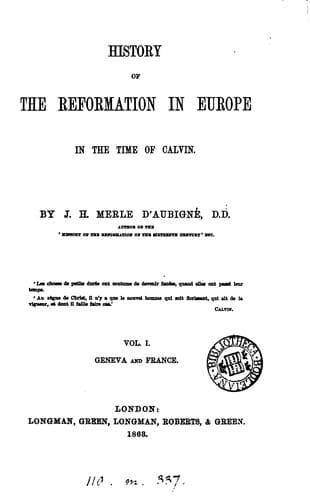
History of the Reformation in Europe in the Time of Calvin, Vol. 6 (of 8)Merle d'Aubigné, J. H. (Jean Henri)
History
History of the Reformation in Europe in the Time of Calvin, Vol. 6 (of 8)
Merle d'Aubigné, J. H. (Jean Henri)
Reformation
Calvin commenced his work as Reader in the Holy Scriptures at Geneva,
or, as he styles himself, Professor of Sacred Literature in the
Genevese Church. His lectures were delivered not in any house or in
any academic hall, but in the cathedral itself, a circumstance which
invested his teaching with an importance of which Calvin had certainly
not dreamed. The doors were opened for this novel service in the
afternoon, and the Genevese, who felt the need of substantial teaching,
crowded to hear the young doctor. He expounded several books of the
New Testament, particularly the Epistles. One characteristic of his
manner of teaching at Geneva from the first was the combination of
simplicity and solidity. A new light was then rising. It was not,
to be sure, the sun in its brightness. The timidity and the shyness
which Calvin attributes to himself may well have shown themselves in
his first attempts. The _Commentaries_ on the New Testament, which he
published at a later period, have a completeness which his earliest
expositions could not attain. But they are a sufficiently faithful
representation of the kind of teaching which he adopted at St. Peter’s
church. It was not grammatical and etymological explanation of the
text; nor was it, on the other hand, a pathetic discourse. Calvin set
forth in clear light everything in the Scriptures which characterizes
the Christian doctrine and life. He first meditated on his subject,
then delivered his lectures extempore; and the animated and powerful
individuality of the master imparted to them an influence which carried
away and multiplied his hearers. It was not in his nature to do a
merely intellectual task. He consoled, he exhorted, he censured. But
his chief aim was to illustrate the labor of love which Jesus Christ
had accomplished, and to make known its necessity and grandeur. Two
points in the Christian doctrine especially struck him, the one dark
and mournful, the other bright like sunshine. ‘Our souls,’ said he,
‘are an abyss of iniquity, so that we are compelled to have recourse to
the fountain of all good, which is Jesus Christ.’[378]
[Sidenote: CHURCH DISCIPLINE.]
Public-domain text, read in full here on John Shaqi.
Reviews
Reviews
No reviews yet
Be the first to share your thoughts on this work.
Elsewhere in the archive
Join the Discussion
Join the discussion
Sign in to leave a comment or review.
Sign InorCreate an account