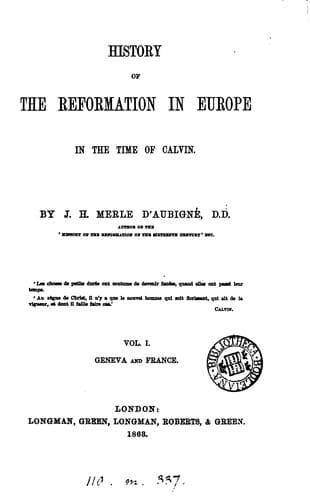
History of the Reformation in Europe in the Time of Calvin, Vol. 6 (of 8)Merle d'Aubigné, J. H. (Jean Henri)
History
History of the Reformation in Europe in the Time of Calvin, Vol. 6 (of 8)
Merle d'Aubigné, J. H. (Jean Henri)
Reformation
The exposition, defence, and application of the great facts of
Christianity formed the substance of Calvin’s work at Geneva and in
Christendom. It is a mistake to suppose that his principal business was
the introduction and the maintenance of discipline in the Church. It is
not to be doubted that he wished for order: that he wished absolutely
for a Christian way of life; but it was not he who, as some believe,
first introduced measures of discipline, nor was the maintenance of
those measures the task of his life. Speaking of them,[379] he defends
himself from the charge of being their author. ‘I observe and do
whatsoever I have found,’ said he, ‘as one who takes no pleasure in
making any innovation.’ It was the magistrate, who, being in Geneva
head both of the Church and of the state, prescribed and enforced the
laws of discipline. Before Calvin’s arrival at Geneva, we have seen how
De la Rive was sentenced to banishment for having his child baptized
by a priest. The year before some men, women, and magistrates had
been condemned to the _crotton_ (black hole) for immorality. At the
moment at which this stranger, whose name even was hardly known, had
just crossed the threshold of the city--on the eve of the day on which
Farel was to introduce him to the magistrate (Monday, September 4,
1536)--a remarkable scene was taking place in the Council of the Two
Hundred, which seems placed at that epoch as if on purpose to resolve
distinctly the question which engages our attention. ‘Gentlemen,’ said
the syndics, ‘we have all pledged ourselves in public council to live
according to the Gospel, and nevertheless there are some here who do
not go to preaching.’ At these words the councillor and former syndic
Richardet, a fine, tall, and powerful man, but very passionate, rose
in wrath and exclaimed with loud voice, ‘Nobody shall lord it over my
conscience; and I will not go to sermon at the bidding of a Syndic
Porral.’[380] Porral, a man of highly cultivated mind and a very
active magistrate, had declared himself decisively for the Reform,
and he was even charged to prosecute certain classes of delinquents.
It had been enacted, on July 24, that those who refused to go to the
preaching must quit the city in ten days. Richardet was not alone in
his resolution. The question having been put to J. Philippe and two
other councillors whether they would attend the preaching of the Word
of God, ‘We will not be compelled,’ they said, ‘but will live in our
liberty.’ These citizens were right in maintaining their liberty, and
the magistrates were in the wrong. Calvin was far away from Geneva on
July 24; and, generally speaking, he was not of so peremptory a temper
as some imagine. There was a certain sphere in which he maintained
liberty, and maintained it even against powerful adversaries. ‘Touching
ceremonies,’ thus he wrote to the formidable lords of Berne, ‘they are
things indifferent, and the churches are free to adopt a diversity of
Public-domain text, read in full here on John Shaqi.
Reviews
Reviews
No reviews yet
Be the first to share your thoughts on this work.
Elsewhere in the archive
Join the Discussion
Join the discussion
Sign in to leave a comment or review.
Sign InorCreate an account