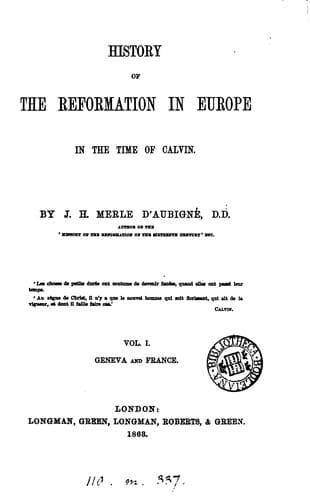
History of the Reformation in Europe in the Time of Calvin, Vol. 6 (of 8)Merle d'Aubigné, J. H. (Jean Henri)
History
History of the Reformation in Europe in the Time of Calvin, Vol. 6 (of 8)
Merle d'Aubigné, J. H. (Jean Henri)
Reformation
Farel, Viret, and other evangelists, as already related, had introduced
the Reformation into such parts of that country as were subject to
the Swiss cantons; but the other parishes of that fair land had
still remained subject to the pope. Meanwhile Luther’s writings were
everywhere circulated, the eyes of the people began to be opened,
and several evangelists, particularly Jean Lecomte, a gentleman of
Picardie, had preached the Gospel in various places. The occupation
of the country by the Bernese, on occasion of the expedition which
delivered Geneva in 1536, hastened the fall of Roman Catholicism. When
the Bernese had taken Yverdon with the sword, they transformed the
church of that town in a somewhat soldierly fashion. They bluntly put
an end to the exercise of the Romish religion; appointed Malingre to
be minister; on March 15 had their religious ordinances published;
burnt, March 17, the images out of the churches in the market-place,
and ordered the ministers to preach in temples cleared of those
abominations. Lecomte, Tissot, Meige, and other evangelists introduced
the Reform, but by the spiritual means of preaching, at Cossonay,
Montagny, Yvonand, Sainte-Croix, and other places. Avenches and Lutry
showed themselves decidedly Catholic, and they determined that if by
any chance a minister should go there, they would not go to hear him.
[Sidenote: THE GOSPEL IN THE PAYS DE VAUD.]
In March 1536, as Viret and Fabry were passing near Yverdon during the
siege of that town by the Bernese army, some Lausannese officers who
were serving in it and who were acquainted with Viret, stopped him and
said, ‘When Yverdon is taken, we shall go to Lausanne: come with us
and preach the Gospel there in spite of the bishop.’ They did so. The
amiable and discreet Viret would have been ill pleased to see Lausanne
reformed by the military method, like Yverdon. He preferred the sword
of the Spirit to that of the Bernese soldiery. He would choose that, in
the sloping streets of that city and within its beautiful cathedral,
the still small voice should be heard, and not the hissing of the
tempest and the crash of thunder. He preached therefore the ‘glad
tidings of great joy,’ and preached them with success, in the church
of the convent of St. Francis. The Canons complained bitterly to the
council. ‘A strange thing this,’ they said, ‘to see in Lausanne _two_
preachers at a time! A whole multitude of do-nothing monks, well and
good! But two preachers of Jesus Christ, what useless waste!’ ‘The less
preaching there is the better,’ said the friends of Rome. ‘The more
preaching the better,’ said the friends of the Gospel. If the Canons
did their duty, remarked some one, instead of two preachers we should
have thirty.[385] The burgesses, as usual, took a middle course which
must fail to satisfy either one party or the other. They resolved that
the evangelists should preach in the church of Mary Magdalene, but
Public-domain text, read in full here on John Shaqi.
Reviews
Reviews
No reviews yet
Be the first to share your thoughts on this work.
Elsewhere in the archive
Join the Discussion
Join the discussion
Sign in to leave a comment or review.
Sign InorCreate an account