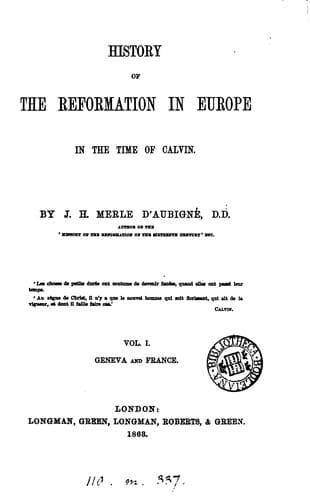
History of the Reformation in Europe in the Time of Calvin, Vol. 6 (of 8)Merle d'Aubigné, J. H. (Jean Henri)
History
History of the Reformation in Europe in the Time of Calvin, Vol. 6 (of 8)
Merle d'Aubigné, J. H. (Jean Henri)
Reformation
without removing the altars, the fonts, the organs, the images, and
other decorations, ‘which did no harm to anybody,’ said the burgesses;
and that the friars of the Dominican order should also celebrate in the
same church the Roman Catholic service in the usual way.[386] That is
what the great Saxon reformer called ‘trying to bring together Luther
and the pope.’
[Sidenote: IMAGE WORSHIP.]
Viret therefore preached in that church. But when Lent was come, the
Dominican Monbouson began to discourse in the cathedral, and maintained
their Romish traditions with violence and plenty of lying. Viret was
informed of it, and as he thought that the best way to refute the
papal doctrine was to make it distinctly known, he put in writing the
assertions of the friar and called upon him publicly to defend them,
announcing that he was prepared to reply to him. Monbouson felt strong
enough to maintain his thesis when he stood surrounded by a whole
phalanx of scholastic doctors and had nobody to contradict him, but he
grew pale in the presence of the young Viret. ‘Ah,’ said he, ‘I would
gladly do what you propose at Avignon, at Paris, or at Dôle; but at
Lausanne there is nobody capable of judging of the matter.’--‘You ought
then to preach only at Dôle, Paris, or Avignon,’ replied Viret; ‘but
since you have lied at Lausanne, it is at Lausanne that satisfaction
is due.’ Then the friar, anxious to get out of his embarrassment,
withdrew in the quietest manner and disappeared.[387] The reformed
Christians did not think, with those gentlemen of Lausanne, that
images, altars, etc., did nobody any harm. They believed that the
paintings did harm. They believed that the people, thanks to the
images, made for themselves many minor gods before which they bent
their knees in order to obtain this or that favor, or the healing of
this or that malady: that the visible made them forget the invisible:
that it was frightful to think that, every time some simple soul
came to worship God in his temple, those figures of saints became
occasions of falling or of scandal. ‘Alas!’ they said, ‘how many
poor creatures called to be children of God have been made by those
images children of the devil!’ Those, therefore, of the reformed of
Lausanne, in whose judgment the pictures of saints and angels seduced
and almost inevitably led astray the weak, began to stir in the matter.
Commencing with the church of the Magdalene, they removed the images
and the altars and broke or burnt them. Then betaking themselves
to the church of St. Francis, they did the same there, and counted
themselves happy in thus keeping the commandment, _Thou shalt have
no other gods before me_. The old folk of Lausanne, who were already
disconsolate at being left without a bishop, were still more distressed
when they found themselves deprived of their images and their masses;
and they sent deputies to Berne to complain of it. The Bernese council
listened to them with all politeness, and dismissed them with good
words.
Public-domain text, read in full here on John Shaqi.
Reviews
Reviews
No reviews yet
Be the first to share your thoughts on this work.
Elsewhere in the archive
Join the Discussion
Join the discussion
Sign in to leave a comment or review.
Sign InorCreate an account