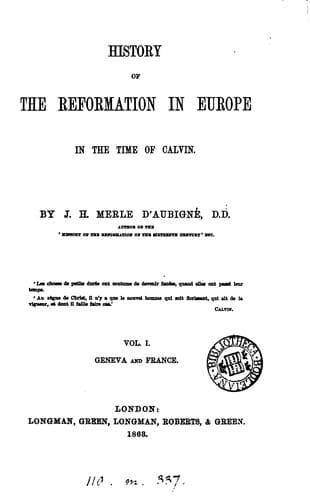
History of the Reformation in Europe in the Time of Calvin, Vol. 6 (of 8)Merle d'Aubigné, J. H. (Jean Henri)
History
History of the Reformation in Europe in the Time of Calvin, Vol. 6 (of 8)
Merle d'Aubigné, J. H. (Jean Henri)
Reformation
Lausanne then sent another deputation, consisting of twelve
persons of distinction. At Berne they were asked, ‘What is it that you
want?’ ‘Two masses weekly,’ they replied, according to a Lausannese
manuscript.[388] If the statement is true, the request was certainly
very moderate for zealous Catholics. The concession was made to
them, but it was coupled with the condition that they should provide
ministers for all the churches that asked for them. At the same time
they gave them to understand that it would be well to hold at Lausanne
a great disputation on religion, in order to decide between Rome and
Reform. That was a good deal to ask for the two masses which were
granted them.
The Bernese, indeed, were anxious that the Vaudois, whose country they
had recently conquered, should attach themselves to the Reformation.
It was no doubt partly from a regard to political interests that they
wished this, but they did not overlook the interest of religion.
Be that as it may, the reformation of religion in that country was
a source of great prosperity both temporal and spiritual. The Pays
de Vaud was to offer the stranger, at a later time, not only those
beauties of nature which excite our admiration, but still more,
numerous examples of sincere and vital piety, which is far sweeter
and pleasanter than its lakes, and more sublime than its peaks and
glaciers. The seed which was scattered at the epoch of the Reformation,
in its valleys and on its mountains, was truly the Word of God; and one
cannot but see there the fulfilment of that ancient oracle, _He that
soweth to the Spirit shall of the Spirit reap everlasting life_.
The conversion of Yverdon had been somewhat checked by the siege which
the town had sustained. The lords of Berne wished in general to employ,
like Viret, evangelical means; to reveal to their new subjects the
grosser superstitions under whose yoke they had been held, and to give
them the knowledge of the truth. For that end they resolved to appoint
first a public disputation such as had been held at Zurich, Berne,
and Geneva. As soon as the report was circulated in the country that
a great assembly for discussion on matters of faith was to be held at
Lausanne, the priests and their friends were alarmed. The excitement
extended to all the villages. The friends of the papacy expected to see
black clouds gathering on the horizon, and a violent storm presently
burst on the old ship which had carried their fathers, and make it
founder, thus engulfing in the depths of the sea all the traditions of
their doctrine and all the pomps of their worship. They determined to
do everything in their power to oppose such an assembly, and they wrote
to the bishop and to the council at Friburg, to the pope and to the
emperor.
[Sidenote: A DISPUTATION APPOINTED.]
Public-domain text, read in full here on John Shaqi.
Reviews
Reviews
No reviews yet
Be the first to share your thoughts on this work.
Elsewhere in the archive
Join the Discussion
Join the discussion
Sign in to leave a comment or review.
Sign InorCreate an account