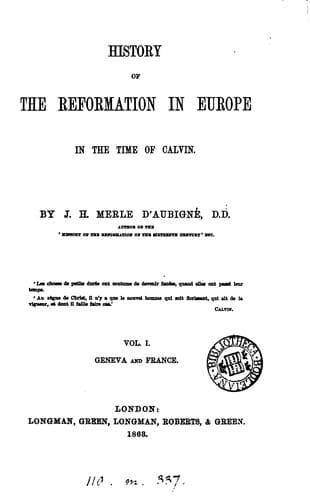
History of the Reformation in Europe in the Time of Calvin, Vol. 6 (of 8)Merle d'Aubigné, J. H. (Jean Henri)
History
History of the Reformation in Europe in the Time of Calvin, Vol. 6 (of 8)
Merle d'Aubigné, J. H. (Jean Henri)
Reformation
A few days after the edict of Berne, some Savoyard ambassadors, on
their way to the diet of Berne, delivered the emperor’s letter to
the council of Lausanne. That body having laid on the table side by
side the epistle of his Catholic majesty and the edict of the lords
of Berne, found themselves, to their great dismay, placed between the
anvil and the hammer. Pressed thus by the two conflicting parties,
they foresaw nothing but calamity whether they resisted the one or
the other. The imperial document was read to the general council July
23. Its members, the majority of whom were attached to the Romish
Church, thought that the wisest plan was to obey the most powerful,
and therefore, sheltering themselves under the order of the great
potentate, they enacted that the parties should live peaceably
together, but that no innovation should be made until after the
decision of the council. At the same time a deputation set out for
Berne in order to prevent the disputation. But all was useless. Berne
was stronger than the Emperor Charles V. That prince was in Italy, and
the absent are in the wrong.
CHAPTER II.
THE DISPUTATION AT LAUSANNE.
(OCTOBER, 1536.)
[Sidenote: THE DISPUTATION AT LAUSANNE.]
The disputation of Lausanne inaugurates with a certain grandeur the
Reformation of the Vaudois. Some look upon it as merely a Bernese
project. But that imposing assembly, among whose speakers were all or
nearly all the reformers of western Switzerland; at which the great
evangelical questions were discussed; and by means of which some of
those who were present were converted; is evidence that the Reform
was truly the work of God. The Reformation had begun in that country,
obscurely and modestly, in some districts on the banks of the Rhone,
on the shores of the lake of Neuchâtel, and in others besides. It now
announced itself with power, and the mass of the people were going to
embrace it. Men discourse much in books about the beautiful. We find
true beauty, Christian beauty, evangelical, inward, more veiled perhaps
than that of the world, but more pure and more solid, in the doctrine
then proclaimed at Lausanne, and often in the manner in which it was
set forth, although we have to make allowance for the time. We find it
in the Farels, the Calvins, the Virets and other heroic men of that
epoch, who lived with God, who were unwearied in their work, and were
always ready to give their lives for the truth which they proclaimed.
That synod was a beautiful portico erected to lead men into a temple of
divine beauty.
[Sidenote: PREPARATIONS AT LAUSANNE.]
Public-domain text, read in full here on John Shaqi.
Reviews
Reviews
No reviews yet
Be the first to share your thoughts on this work.
Elsewhere in the archive
Join the Discussion
Join the discussion
Sign in to leave a comment or review.
Sign InorCreate an account