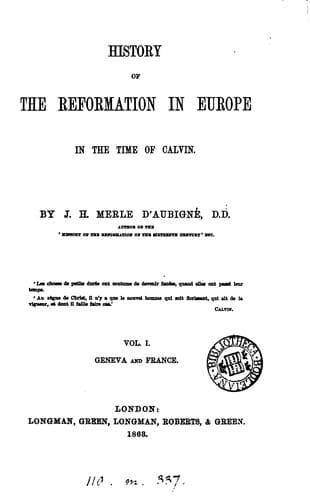
History of the Reformation in Europe in the Time of Calvin, Vol. 6 (of 8)Merle d'Aubigné, J. H. (Jean Henri)
History
History of the Reformation in Europe in the Time of Calvin, Vol. 6 (of 8)
Merle d'Aubigné, J. H. (Jean Henri)
Reformation
Farel was preparing for the disputation; and on the Roman Catholic
side there was much ado to find valiant champions. At Lausanne there
was no canon, no priest, no monk who came forward to defend the
doctrine by which till that day they had lived. It was necessary to
beat to arms elsewhere. They did so; and at the end of September
the Dominican Monbouson, Michod dean of Vevey, the vicars Drogy
and Berrilly, and others besides, arrived, in the town. Two laymen
alone represented Lausanne, the captain of the youth,[392] Fernand
de Loys, and the French physician Blancherose. The latter was ‘_un
homme tenant de la lune_’ (something of a lunatic), said the Catholic
Pierrefleur, ‘who blends in his discussions medicine and theology, and
excites boundless merriment.’ Viret, Marcourt, and Lecomte appeared
for the reformed. From Geneva came Chapuis, a former Dominican, then
pastor at Compesières, and Jacques Bernard, formerly superior of the
Cordeliers. But the man who chiefly attracted attention was Farel, who
was accompanied by a young man pale and modest, unknown by sight to
most, and who appeared to be his assistant. It was John Calvin. Farel
had urged him to come to Lausanne, but Calvin shrank from the thought
of speaking in that great assembly. Still he was deeply interested in
its proceedings. ‘The Senate of Berne,’ said he, ‘has declared that
everyone is at liberty to state his objections freely, without need to
fear being disturbed in consequence of it. That is the fittest means
of exposing the ignorance of those who set themselves against the
Gospel.’[393] These two men had set out in company with the Syndic
Porral, and they arrived with many others at the cathedral, in which
the disputation was to be held. An amphitheatre had been constructed.
The altars, pictures, statues, and rich ornaments of the Romish worship
still displayed their magnificence; and even the canons, who were
determined to keep silence, but nevertheless wished to do something,
had brought out of their hiding-places the image of the holy Virgin and
all those of the saints, trusting more, it would seem, to the eloquence
of those dumb figures than to their own.
Public-domain text, read in full here on John Shaqi.
Reviews
Reviews
No reviews yet
Be the first to share your thoughts on this work.
Elsewhere in the archive
Join the Discussion
Join the discussion
Sign in to leave a comment or review.
Sign InorCreate an account