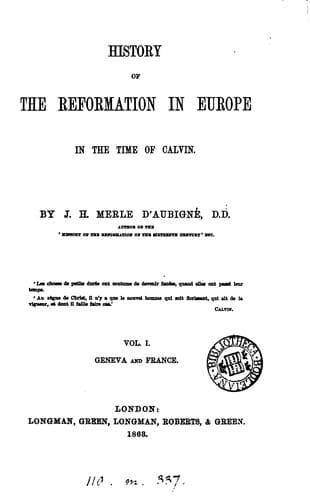
History of the Reformation in Europe in the Time of Calvin, Vol. 6 (of 8)Merle d'Aubigné, J. H. (Jean Henri)
History
History of the Reformation in Europe in the Time of Calvin, Vol. 6 (of 8)
Merle d'Aubigné, J. H. (Jean Henri)
Reformation
us not shut the door of the kingdom of heaven and take away the key of
knowledge. Let us be free from all hatred and rancor. Let us love all
men, pray for all men, do good to all men. Let us visit the poor and
the afflicted, that is the true pilgrimage. Those little ones are the
images of God, and it is to those images that we ought to resort, to
them that we should carry food and candles.... My dear brethren, when
you hear the bell ring, present yourselves here in God’s name, in peace
and unity, without disturbance or murmuring.’ This was indeed a good
and Christian address, and after hearing it the assembly dispersed.
[Sidenote: FAREL’S DISCOURSE.]
On Monday, October 2, at seven o’clock in the morning, the cathedral
was again filled, and ‘as soon as the shrill sound of the bell had
ceased, there appeared on the platform the ambassadors of Berne,’ J.
J. de Watteville, formerly _avoyer_,[396] J. de Diesbach, and the
_baillifs_ of Yverdon and Lausanne. They were easily recognized by
their red and black doublets, skirts, and hose. The council of Geneva
had sent as its representative the Syndic A. Porral, a warm friend
of Reform. Presidents were chosen from among the men of Berne and
Lausanne. Then Farel rose and read his first thesis, which treated of
man’s justification before God, developed and proved it.
When he had finished, the vice-bailiff of Lausanne said aloud, ‘If
any man has aught to say against these first conclusions, let him
come forward and we shall willingly listen to him.’ The canons of the
cathedral then rose, who were determined not to carry on but to prevent
the discussion, and one of them, Perrini, said, ‘When doubts arise
respecting the faith, they must be resolved according to the true sense
of the Scriptures. Now, that is lawful only to the Church universal,
which is not liable to error. Therefore, we, the provost and canons of
this church, do solemnly protest against this controversy, and refer it
to the next council.’[397]
Public-domain text, read in full here on John Shaqi.
Reviews
Reviews
No reviews yet
Be the first to share your thoughts on this work.
Elsewhere in the archive
Join the Discussion
Join the discussion
Sign in to leave a comment or review.
Sign InorCreate an account