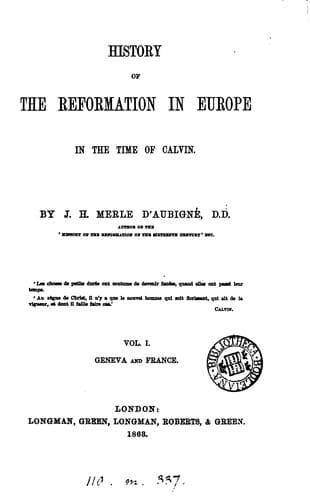
History of the Reformation in Europe in the Time of Calvin, Vol. 6 (of 8)Merle d'Aubigné, J. H. (Jean Henri)
History
History of the Reformation in Europe in the Time of Calvin, Vol. 6 (of 8)
Merle d'Aubigné, J. H. (Jean Henri)
Reformation
On Tuesday, October 3, Dr. Blancherose (of whom it was said _il tenait
de la lune_) addressed the assembly. Even if the clergy were silent he
thought himself quite competent to maintain his cause. ‘Magnificent
and mighty lords,’ he began, ‘I am a physician; my profession is that
of medicine, not that of theology.’ To which Farel politely answered,
‘To be a physician does not at all clash with true theology. St. Luke
was a physician likewise.’--‘I have taught,’ said Blancherose, ‘in many
cities and universities of France; moreover, I was once physician to
the king, and afterwards to the princess of Orange.’ He then began to
set forth strange theories on what he called the _monarchies_ of the
Father, the Son, and the Holy Ghost. Caroli was present. It is known
that this inconsistent and whimsical man was sometimes a Papist and
sometimes a Protestant. For the moment he was Protestant. So he raised
the cry, just as if he were with a hunting party, ‘A hare started out
of the Donatist warren!’ The priests themselves were not particularly
pleased with their lay companion in arms. Mimard, therefore,
schoolmaster of Vevey, and Jacques Drogy, vicar of Morges, hastened to
the rescue, hoping to retake from the enemy what he had carried off.
But their attempt had no great success.
Drogy renewed his speech on Wednesday, October 4. He must have
known well what kind of life was led by many priests, monks, and
laymen, who at the same time that they were doing everything to save
themselves by legal works, found therein a support, and, so to say, an
indulgence, for giving themselves up unscrupulously to an impure life.
Nevertheless, he showed that he was greatly alarmed, and no doubt
sincerely, at the dangers to which the doctrine of justification by
faith alone would expose the work of sanctification. He therefore said,
‘If you say that a man is justified by faith and not by works, people
will not take the trouble to live well.’ Drogy was seeking light. The
sayings of the reformers had disturbed him, and all that he desired was
to see the truth clearly.
[Sidenote: THE CHURCH AND THE SCRIPTURES.]
Public-domain text, read in full here on John Shaqi.
Reviews
Reviews
No reviews yet
Be the first to share your thoughts on this work.
Elsewhere in the archive
Join the Discussion
Join the discussion
Sign in to leave a comment or review.
Sign InorCreate an account