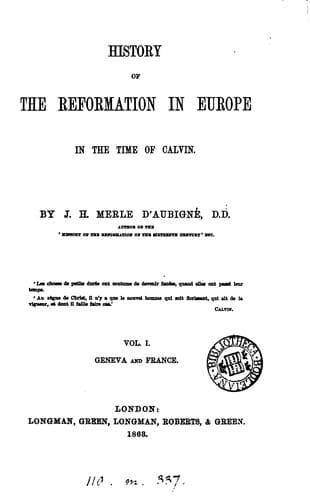
History of the Reformation in Europe in the Time of Calvin, Vol. 6 (of 8)Merle d'Aubigné, J. H. (Jean Henri)
History
History of the Reformation in Europe in the Time of Calvin, Vol. 6 (of 8)
Merle d'Aubigné, J. H. (Jean Henri)
Reformation
Caroli, once Romanist and now Protestant, whose inconsistencies we
have seen and shall again see, spoke on this occasion with fairness.
As doctor of the Sorbonne and a man of intelligence, he was well
acquainted with the doctrine; only he did not walk according to its
teaching. He rose and said, ‘To allege that works must be partners in
justification is to enervate Jesus Christ; that is, to say that he
alone is not sufficient to justify us. If a man be absolved through
faith, it is certainly not in order that he may again begin doing evil.
Just as when a king grants a pardon, it is not that the man may repeat
his offence. God forgives all my offences only in order that I may do
good works. Are you not yourselves in the habit of saying to a dying
man, God is a greater _pardoner_ than man is an offender? The death of
Jesus is more effectual in the punishment of sin than the death of all
mankind.’[399]
The laity were ashamed to see their cause so ill defended by their
priests. The captain of the youth of Lausanne, Fernand de Loys,
therefore entered the lists. He was a clear-headed man; he had learnt
carefully some theses of the Romish theology, and had a little of that
presumption which is frequently seen in the young men of whom he was
one of the chiefs. He came forward, with his baton raised, speaking
bluntly and without palliation. ‘The Church is before the Scripture,
worthier than the Scripture, and invested with higher authority.
Now the Church teaches justification by works.’ Farel, roused by
hearing such assertions, exclaimed, ‘Which is first, the Church or
the Scripture?... Certainly, the Scripture is before the Church. The
Church has its existence through the Word of God; and Jesus himself
proved what he said by reference to the Scriptures.’ Upon this the
physician Blancherose thought he must come to the aid of the captain of
the young men, and said to Farel, ‘In saying so much of faith, and in
making it the cause of all good, you are very much like the sorcerers
and enchanters, who, through the faith which they have in certain
words, pretend to do so many great and wonderful things.’ Farel, taking
little heed to these jests, said, ‘Jesus was beaten and wounded; he
bore the discipline for our sakes; for us he died.’ The master of the
Catholic school of Vevey, who was present, seems to have had a truer
Christian feeling than his colleagues, and, profiting by Farel’s words,
he said, ‘Precisely so; it is Jesus who justifies us, and not faith.’
This was more serious. Farel therefore supported the first part of the
proposition. In opposing the second part, he said--‘Yes, it is Jesus
alone who justifies; but he justifies only those who receive him by
faith, and he dwells in those who believe. But as for those who do not
believe in him, he is for them only a stone of stumbling and of ruin.’
Public-domain text, read in full here on John Shaqi.
Reviews
Reviews
No reviews yet
Be the first to share your thoughts on this work.
Elsewhere in the archive
Join the Discussion
Join the discussion
Sign in to leave a comment or review.
Sign InorCreate an account