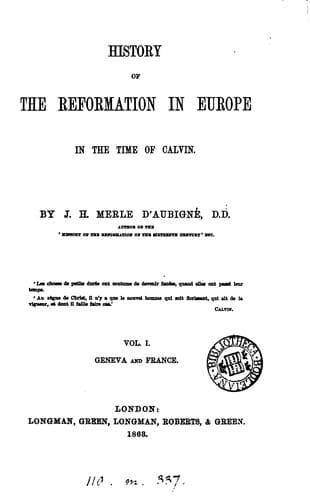
History of the Reformation in Europe in the Time of Calvin, Vol. 6 (of 8)Merle d'Aubigné, J. H. (Jean Henri)
History
History of the Reformation in Europe in the Time of Calvin, Vol. 6 (of 8)
Merle d'Aubigné, J. H. (Jean Henri)
Reformation
Calvin had not with him the voluminous works of the fathers; but his
memory was a library abridged. Tertullian, Chrysostom, and the writers
of his time, especially Augustine, came immediately to his aid.
‘Tertullian,’ said he, ‘when refuting Marcion, speaks thus, “Christ
in the supper has left us the _figure_ of his body.” The author of
the commentary on St. Matthew, contained in the works of Chrysostom,
says, “It is a far greater offence to defile ourselves, who are the
true vessels in which God dwells, than to profane the vessels in which
the supper is administered, since that _the real body of Jesus Christ
is not contained in them_, but only the mystery of his body.” St.
Augustine, in his twenty-third Epistle,[401] says, “The bread and the
wine, which are sacraments of the body and blood of Christ, _we call
them in a certain sense_ (_quodammodo_) his body and his blood.” And
in his book against Adimantus, he adds, “The Lord did not hesitate to
say, This is my body, when he gave the _sign of his body_.” Weigh all
these words, every syllable of them if you will, and see whether these
declarations in any way favor your error. When you taunt us with the
charge that the ancients are against us, everybody sees your rashness.
Assuredly, if you had read only a few pages you would not have been
so bold; but you have not even seen the covering of the book. The
foregoing testimonies, which may easily be pointed out, prove it.’
[Sidenote: DOCTRINE OF THE FATHERS.]
At this point, Calvin, wishing to show fully how chimerical the Romish
opinion is, offered one or two considerations which, while they display
his fine intelligence, are not lacking in solidity. ‘It is not without
reason,’ he said, ‘that we reject the foolish opinion which the craft
of Satan introduced into the world. In the supper we certainly eat
the same body of Christ as the apostles ate at its institution, and
it must be either his mortal body or his glorified body. If it be his
mortal body, Jesus is then at this hour mortal and passible, while the
Scripture declares to us that he has laid aside all infirmity. If it
be his immortal and glorified body, Jesus, at the first supper, was in
a certain place (seated at the table) in his mortal and passible body,
and he was in another place (in the hands and mouths of his disciples)
in his immortal and glorified body. The dreams of Marcion were never so
fantastic!...’
Public-domain text, read in full here on John Shaqi.
Reviews
Reviews
No reviews yet
Be the first to share your thoughts on this work.
Elsewhere in the archive
Join the Discussion
Join the discussion
Sign in to leave a comment or review.
Sign InorCreate an account