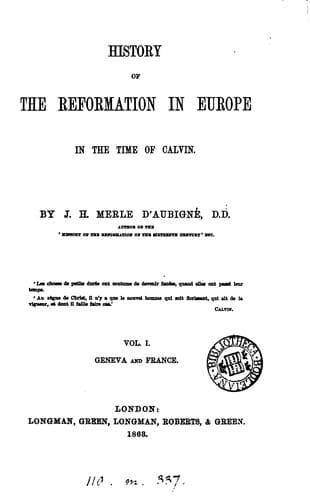
History of the Reformation in Europe in the Time of Calvin, Vol. 6 (of 8)Merle d'Aubigné, J. H. (Jean Henri)
History
History of the Reformation in Europe in the Time of Calvin, Vol. 6 (of 8)
Merle d'Aubigné, J. H. (Jean Henri)
Reformation
Calvin, however, went further and, knowing the importance which Rome
attached to the letter, felt bound to show to what that method leads.
He has explained his own doctrine elsewhere in a more complete manner,
but we must not suppress what he said on this solemn occasion. ‘If you
tie yourselves to words,’ said he, ‘if you so rigorously insist on
these words, _Hoc est corpus meum_, you are compelled by such verbal
strictness to separate the body of the Lord from his blood. For he
said, _This is my body_, pointing to the bread, and when pointing to
the wine, _This is my blood_. Now, to imagine that the body of Christ
was separated from his blood is an abominable thing. I know that you
evade this by what you call the _concomitance_. But do not allege it,
for it is mere mockery. If the real body is in the cup, as you affirm
it to be, the Lord of truth then spoke falsely when he said, _This is
my blood_.
‘No, it is neither the natural body nor the natural blood of our Lord
Jesus which is given to us in the holy supper. But there is a spiritual
communication, by virtue of which he gives to us all the grace that
we can receive from his body and his blood. _Christ makes us truly
participants, but altogether in a spiritual way, by the bond of his
Holy Spirit._ St. Luke and St. Paul write that Jesus said, _This is
the new testament in my blood_; that is to say, the new alliance which
the Father has made with us, blotting out our iniquities by his mercy,
receiving us into his favor that we may be his children, and writing
his law in our hearts by his Spirit; an alliance really new, and
ratified and confirmed by the body and the blood of Jesus Christ.
‘Constrained by reasons so forcible, we interpret the Scripture
according to the true analogy of faith. We do not put glosses on it out
of our own heads, and we give no explanation which is not expressed in
itself.’
[Sidenote: CONVERSION OF JEAN TANDY.]
Calvin was silent. The young man, whose face was unknown but full
of expression, had been listened to with astonishment, and people
recognized in him a master. Everyone felt the force of his words,
and no one raised an objection. ‘At this point,’ say the Acts of the
Disputation, ‘both the Mimards and the Blancheroses remained without
making any attempt to reply.’ The minds of the hearers seemed to be
enlightened by fresh knowledge. This was soon evident.
Public-domain text, read in full here on John Shaqi.
Reviews
Reviews
No reviews yet
Be the first to share your thoughts on this work.
Elsewhere in the archive
Join the Discussion
Join the discussion
Sign in to leave a comment or review.
Sign InorCreate an account