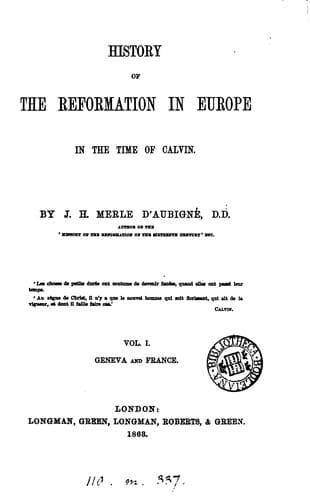
History of the Reformation in Europe in the Time of Calvin, Vol. 6 (of 8)Merle d'Aubigné, J. H. (Jean Henri)
History
History of the Reformation in Europe in the Time of Calvin, Vol. 6 (of 8)
Merle d'Aubigné, J. H. (Jean Henri)
Reformation
It was the intention of the authorities to oppose the arbitrary removal
of images by private persons. But these same authorities lost no time
in suppressing them by their own act throughout the country. A few days
later, Thursday, October 19, the chief magistrate and the councillors
of Berne addressed all their trusty subjects of Vaud, and announced
to them by proclamation that being bound to govern them not only by
means of ‘corporal and outward ordinances, but also by exercising all
diligence to see that they walked according to the will of God, in
the true and living faith which brings forth good works; considering
that the ten conclusions which had been discussed at Lausanne were
based on Holy Scripture, they enjoined everyone to abstain from all
papistical ceremonies, sacrifices, and institutions; to cast down
all images and idols, as well as the altars, and this in an orderly
manner without disturbance; to hear the Word of God, to receive the
preachers with kindness, and not to molest and worry them, so that all
may dwell together in true peace, brotherly love and union.’[420] These
ordinances in the matter of religion and worship would seem strange in
our day; and we might wonder whether such would be tolerated even in
Japan. But they were in accordance with the spirit of that time, and
the rulers of Berne were doing their best.
The Reformation achieved greater triumphs still than the abolition of
images. It could count souls won to the Gospel, not only among the
general population of the country, but also among the very champions
of Rome who had encountered Farel. The amiable captain of the youth,
Ferdinand de Loys, embraced the glorious promises of the Gospel,
and subsequently exerted himself with great earnestness to maintain
Protestantism in France. Moreover, a brilliant testimony to his zeal
was given him. Soubise sent him grateful acknowledgment, as well on his
own behalf as on behalf of the prince of Condé, the Admiral (Coligny)
and other princes and lords.[421] By arrangement with the lords of
Berne, Valais, and Neuchâtel, he had sent to him some men; these men
(_gens_), however, we must add, appear to have been not evangelists but
soldiers. A priest who had taken part in the defence of the papacy, but
who had been convinced by the powerful words of the reformers, Dom Jean
Drogy, also embraced the evangelical faith. He became afterwards pastor
at Bevay in the territory of Neuchâtel. Megander, too, wrote on October
19, to the ministers of Zurich, ‘The disputation of Lausanne has had
the happiest results.’
[Sidenote: CAROLI AND VIRET.]
Public-domain text, read in full here on John Shaqi.
Reviews
Reviews
No reviews yet
Be the first to share your thoughts on this work.
Elsewhere in the archive
Join the Discussion
Join the discussion
Sign in to leave a comment or review.
Sign InorCreate an account