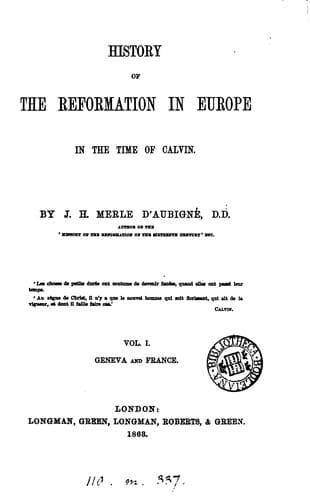
History of the Reformation in Europe in the Time of Calvin, Vol. 6 (of 8)Merle d'Aubigné, J. H. (Jean Henri)
History
History of the Reformation in Europe in the Time of Calvin, Vol. 6 (of 8)
Merle d'Aubigné, J. H. (Jean Henri)
Reformation
These successes encouraged the friends of the Reform, and the Bernese
government demanded of the authorities of Lausanne the definitive
establishment of the evangelical faith and worship. The canons opposed
the measure with all their energy, alleging that reverence is due to
all old customs and religions; they conjured the rulers of Lausanne
not to allow their city to be faithless to Rome. At the same time they
sent deputies to Berne. But the council was already treating with the
lords of Berne, partly swayed by conviction and partly by prudence.
The Bernese were disposed to grant various rights, advantages, and
privileges to their new subjects, on condition of their renouncing the
foreign authority of the pope, with which they well knew that it was
impossible to be on good terms, and of their receiving the Gospel,
which enlightens the mind, gives peace to the soul, and promotes the
prosperity of nations. They knew also that in order to persuade men, it
is necessary to act kindly towards them. Consequently, on November 1, a
contract was concluded at Berne, by virtue of which their excellencies
conceded to the burgesses of Lausanne the higher, middle, and lower
jurisdiction in civil and criminal causes, various convents and abbeys,
the châlet and the mill of Gobet, and certain vineyards. With these
gifts the Bernese coupled the promise that, as soon as ‘popery and
its mummery should be abolished,’ their excellencies would exercise
generosity towards the priests. This _grande largition_ was read on the
5th of the same month in grand council at Lausanne, and was solemnly
ratified. Meanwhile the chiefs of Berne presented, November 5, to the
chiefs of Lausanne, as first pastor, Caroli, who was a doctor of the
Sorbonne, and whose fluent talk and engaging manners prepossessed men
in his favor. At this choice the friends of the Gospel were indignant.
Viret, who had for so many years labored for the diffusion of the
light in his own country, and had done so with perfect earnestness,
wisdom, and self-renunciation, at the risk of his life--Viret, the
true Vaudois reformer--saw this new man, unfit as he was for the work
to be done, preferred to himself. The pastors of Geneva wrote to
Lausanne--‘Everyone knows the labors, the faith, the zeal of Viret,
and we are astonished to learn that they are treating him in that
way. We cannot endure it without complaining. If ever it becomes us
to be indignant, surely it is on this occasion.’[422] The Bernese
lords settled Caroli comfortably in the house of the canon Benoît de
Pontareuse, which had beautiful gardens in which he might philosophize
and entertain himself as Epicurus did of old. They assigned him,
besides, an annual salary of five hundred florins. His wife displayed
a degree of luxury which was offensive. Viret was joined with him
as second pastor, but no tithe was assigned to him, nor any means of
living. De Watteville contented himself with requesting him to show
Public-domain text, read in full here on John Shaqi.
Reviews
Reviews
No reviews yet
Be the first to share your thoughts on this work.
Elsewhere in the archive
Join the Discussion
Join the discussion
Sign in to leave a comment or review.
Sign InorCreate an account