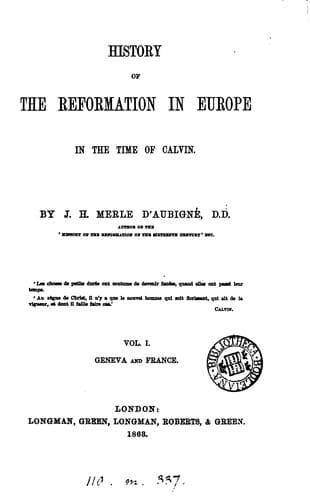
History of the Reformation in Europe in the Time of Calvin, Vol. 6 (of 8)Merle d'Aubigné, J. H. (Jean Henri)
History
History of the Reformation in Europe in the Time of Calvin, Vol. 6 (of 8)
Merle d'Aubigné, J. H. (Jean Henri)
Reformation
Farel, Viret, and Froment had begun the work at the right end. In
building a temple the first process is the cutting of the stones one by
one. Science has sometimes disparaged the individual. She has said, ‘An
individual, of whatsoever species it be, is nothing to the universe;
a hundred individuals, or a thousand, they are still nothing.’[442]
It is not so with individuals that have souls. Christ anticipated
and refuted these audacious assertions when he said, ‘What shall it
profit a man if he gain the whole world and lose his own soul?’ It
was by the conversion of individuals (Cornelius, Lydia, &c.) that the
Apostles established the Christian religion in the world; and it was
by proceeding in the same way that Farel and his friends laid the
foundations of Reform. Calvin, while appreciating this work, felt
nevertheless that another was necessary. After analysis must come
synthesis; and after the individual, society. Catholicism neglected
the individual, and concerned itself almost exclusively with society.
The Gospel proceeds otherwise. Farel had been everywhere, enlightening
minds one by one with the torch of the Word. It was now needful to bind
together the souls thus enlightened. The Christian individual must
first be created, afterwards the Christian Church. The Reformation
had begun in Geneva with the law of life. Another law, the law of
unity, must now be fulfilled. Calvin was alarmed when he considered
the state of Geneva. ‘When I first came into this town,’ said he,
‘there was as it were nothing--no morals, no discipline, no life.
Preaching went on, and that was all. To be sure they burnt the idols,
but there was no reformation at all.’[443] This judgment is perhaps
too severe. It was twenty-eight years after the time referred to that
Calvin thus expressed himself; and the ‘wonderful conflicts’ which he
had been engaged in may possibly have led him to depict in too dark
colors the church which Farel had left to him. Be that as it may,
Calvin, while attaching the utmost importance to individual conversion,
was profoundly convinced that a task of another kind remained to be
achieved. We find that the same conviction possessed Luther when he
returned to Wittenberg after his confinement in the Wartburg. It is the
conviction that upon the revolutionary principle (and the revolution,
we must admit, had been necessary and admirable) the conservative
principle must erect itself.
[Sidenote: DIVISION AMONG THE HUGUENOTS.]
Public-domain text, read in full here on John Shaqi.
Reviews
Reviews
No reviews yet
Be the first to share your thoughts on this work.
Elsewhere in the archive
Join the Discussion
Join the discussion
Sign in to leave a comment or review.
Sign InorCreate an account