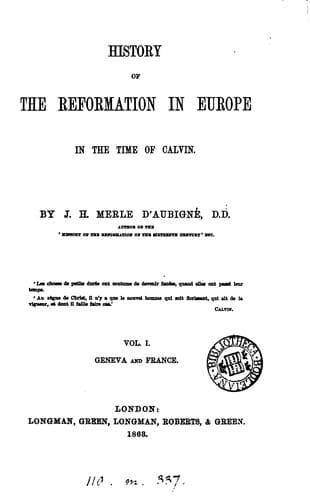
History of the Reformation in Europe in the Time of Calvin, Vol. 6 (of 8)Merle d'Aubigné, J. H. (Jean Henri)
History
History of the Reformation in Europe in the Time of Calvin, Vol. 6 (of 8)
Merle d'Aubigné, J. H. (Jean Henri)
Reformation
When a brilliant victory is won, we usually find, both in the world
and in the Church, that a number of men gather around the victor who
have indeed something in common with him, but who have at the same
time characters and propensities opposed to his own. All who muster
and fight under the same flag, however, have not always the same
thoughts and the same affections as the brave warrior who hoists the
flag. The Genevese, who were designated by the name of Huguenots,
had declared for the Reformation because it attacked the abuses and
the superstitions of popery, and because, in bidding them prove all
things, it restored to them those privileges of free men of which Rome
had robbed them; many had also been attracted by the love of novelty,
others by the prospect of a new career opened to their ambition. There
were doubtless a certain number of citizens who sincerely agreed with
the Reformation, with the faith which it professed, and with the morals
which it prescribed; but they did not form the most numerous class. In
any expedition of great daring, and which exposes to many toils and
privations, we know that many of the soldiers quit the standard under
which they first ranked themselves; so it was inevitable that a large
number of the Genevese would abandon the flag around which they had
rallied, and would place themselves in opposition to the leaders whom
at first they had followed. Calvin was not long in observing this.
‘The abomination of papistry,’ said he, ‘is now cut down by the power
of the Word.[444] The senate has decreed that its superstitions, with
all their _paraphernalia_, shall be suppressed, and that religion
shall be regulated in the city according to the purity of the Gospel.
However, the form of the Church does not appear to us to be such as the
legitimate exercise of our office requires. Whatever others may think,
we for our part cannot imagine that our ministry ought to be anything
so slight as that when once we have preached our sermon, we have
nothing to do but to fold our arms, like people that have done their
task.’
Public-domain text, read in full here on John Shaqi.
Reviews
Reviews
No reviews yet
Be the first to share your thoughts on this work.
Elsewhere in the archive
Join the Discussion
Join the discussion
Sign in to leave a comment or review.
Sign InorCreate an account