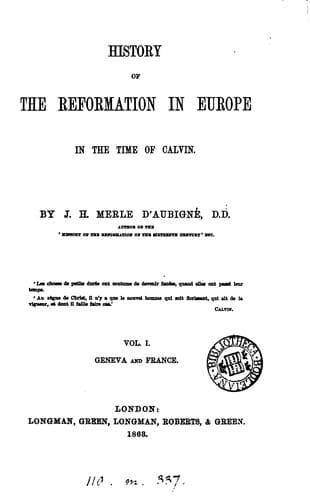
History of the Reformation in Europe in the Time of Calvin, Vol. 6 (of 8)Merle d'Aubigné, J. H. (Jean Henri)
History
History of the Reformation in Europe in the Time of Calvin, Vol. 6 (of 8)
Merle d'Aubigné, J. H. (Jean Henri)
Reformation
A Latin translation of the catechism appeared at Basel in 1538.[448]
This catechism reveals in its first lines the true thought, the real
mind of Calvin. We say the real mind, because it is very different
from that attributed to Calvin by so many men who are filled with
prejudices, and for whom the word _Calvinism_ is like a scarecrow set
up on the top of a pole in the fields to frighten timid birds. ‘There
is not a man in existence,’ said he, ‘no matter how uncivilized he be,
no matter though his heart be altogether savage, that is destitute of
the religious sentiment. It is certain that the end for which we were
created is to know the majesty of our Creator, and to embrace him when
known, and to adore him with all fear, love, and reverence.’[449] Of
course this declaration does not show that Calvin was blind to the
evil that is in humanity. It does not prevent his declaring that ‘the
heart of man, which the poison of sin has penetrated to its inmost
depths, sins, not because it is constrained by necessity, but because
the will impels him to it.’ Calvin afterwards expounds, with the hand
of a master, the three great articles of the Christian Church--the
Decalogue, the Apostles’ Creed, and the Lord’s Prayer. But this is not
the place for a copy of his exposition.
Calvin, at the same time that he provided instruction for the young,
interested himself warmly in the character of the men and women who
were called to become members of the Church of God. As he longed for
a pure Church, his first care was to ascertain the purity of faith
and life of those who composed it. The great diversity of religious
opinions which then prevailed in Geneva troubled him, for he knew
that _every house divided against itself shall not stand_. ‘How,’
said he, ‘can we receive into a Church of the Gospel people who,
for all we know, may not have renounced papistical idolatries and
superstitions?’[450] The members composing a Church ought, in his
judgment, to be united by a bond both holy and strong. As Geneva had to
contend against the Goliath of the papacy, her strength must be found
in faith and union. Sound doctrine must be imprinted on the hearts
of the Genevese, in order that neither mysticism, nor infidelity,
nor a fanatical enthusiasm might approach to enfeeble and lead them
astray. Christians must ‘lean upon the promises of God with trust and
certainty, that they may stand firm against all the artillery which
might threaten the destruction of their confidence.’[451]
Public-domain text, read in full here on John Shaqi.
Reviews
Reviews
No reviews yet
Be the first to share your thoughts on this work.
Elsewhere in the archive
Join the Discussion
Join the discussion
Sign in to leave a comment or review.
Sign InorCreate an account