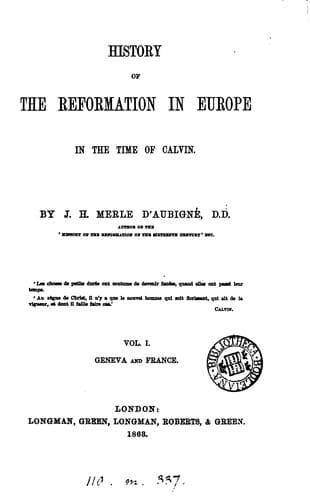
History of the Reformation in Europe in the Time of Calvin, Vol. 6 (of 8)Merle d'Aubigné, J. H. (Jean Henri)
History
History of the Reformation in Europe in the Time of Calvin, Vol. 6 (of 8)
Merle d'Aubigné, J. H. (Jean Henri)
Reformation
Before Calvin’s arrival, Farel had spoken to the council about the
necessity of preparing the edicts for establishing unity in matters
of religion at Geneva, but nothing had been done. Now that Calvin was
come, he conversed with his old colleague on the means of _making the
people live in the faith of God_. The two friends agreed to prepare a
confession of evangelical faith, and the author of the _Institution
chrétienne_ was in reality charged with the task of drawing it up;
not however without consulting Farel, who was better acquainted with
Geneva, and more clearly understood what was expedient, than the
newly arrived teacher. The biographers of Calvin, who were also his
friends and knew his labors better than any one, speak of this matter.
‘When he was named pastor,’ says one of them, ‘he prepared a brief
formulary of doctrine and discipline.’[452] ‘Then (after the Lausanne
disputation),’ says another, ‘a formula of Christian faith was published
by Calvin.’[453] It has been asserted that Calvin’s formula is lost,
but that Farel had at the same time prepared another, and that the
latter is preserved. In this assertion there are two statements highly
improbable: first, that separate confessions of faith were drawn up at
the same time by Calvin and Farel, for the same purpose: second, that
it is Calvin’s which is lost, and Farel’s that is preserved.
[Sidenote: THE CONFESSION OF FAITH.]
Whatever the fact may be, Farel, on November 10, presented the
Confession to the council; and that was quite natural. He had stood
for years in close relation with that body, and was recognized by it
as the chief leader in the Church: while Calvin, a new-comer, and
somewhat shy, was not fond of showing himself, and least of all of
appearing before the Council of the Two Hundred. Farel, therefore,
having been introduced into the hall of the great council, communicated
the document to them. He stood in the presence of the deputies of the
people of Geneva, who were invested with large powers and whom it was
dangerous to offend. But, although he took into consideration the
religious state of those whom he addressed, he laid before them the
purport of the Christian dispensation with that freedom, clearness, and
courage which were characteristic of the epoch of the Reformation, and
which appear strange to a generation more enervated, more unbelieving,
and more timid. ‘The rule of our faith and our religion,’ said he, ‘is
Holy Scripture alone, without admixture of anything invented by the wit
of man. We worship one God only, not putting our trust in any creature,
whether angel or saint, or men still living on the earth. Man, who is
by nature full of corruption, stands in need of enlightenment from God
that he may attain to the true knowledge of his salvation; and all that
is lacking in ourselves we receive from Christ. By his righteousness
we obtain remission of our sins. By the shedding of his blood we are
cleansed from all our stains.
Public-domain text, read in full here on John Shaqi.
Reviews
Reviews
No reviews yet
Be the first to share your thoughts on this work.
Elsewhere in the archive
Join the Discussion
Join the discussion
Sign in to leave a comment or review.
Sign InorCreate an account