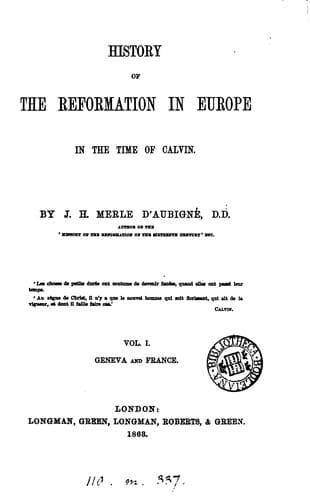
History of the Reformation in Europe in the Time of Calvin, Vol. 6 (of 8)Merle d'Aubigné, J. H. (Jean Henri)
History
History of the Reformation in Europe in the Time of Calvin, Vol. 6 (of 8)
Merle d'Aubigné, J. H. (Jean Henri)
Reformation
By his Holy Spirit we are born again in a
new spiritual nature. By our communion with him, the works which we do
are made acceptable to God.’[454]
It has been observed that this confession of faith, in twenty-one
articles, does not set forth the Christian doctrines in so complete
and didactic a manner as Calvin subsequently did. From this
circumstance it has been inferred that it was composed by Farel. A
reply to this reasoning is furnished in the statement of Theodore
Beza,--that the confession was adapted to the wants of the Genevese
Church, which had then hardly escaped from the corruptions of the
papacy. Calvin and Farel had given especial prominence to those
truths which stood in opposition to papal errors, and had not felt
it necessary to establish the doctrines which the Romish Church
had retained: for example, the doctrine of the Trinity. At a later
period, when these doctrines were controverted by men who professedly
adhered to the Reformation, Calvin felt the need of formally avowing
them; and this he did in his _Sommaire de la doctrine chrétienne_.
Further, we would willingly admit that there may have been, as some
competent judges suppose, a confession of faith prepared by Farel,
and that it was that which was presented to the people, if the two
contemporary writers whom we have cited were not silent about such
a document, and did not insist on that of which Calvin was author.
But there is stronger evidence still. Calvin himself, when speaking
of the publication of his catechism, says, ‘that he annexed to it _a
confession which was sanctioned_ (_editam_, published) _by the solemn
oath of all the people_.’[455] To us this appears to be decisive.
We shall presently see that the spirit pervading that confession is
exactly the spirit which at that time animated Calvin. If anyone
asserts the contrary, he must have forgotten the dispute which took
place between Calvin and Caroli. The best reception was given to the
work from the moment of its presentation to the government. The council
resolved, say the registers, that the articles proposed by Farel should
all be adopted.[456]
[Sidenote: FREQUENT COMMUNION.]
If the rule of faith were Christian, the rule of morals must be pure.
At the beginning of the year 1537, Calvin, doubtless in conjunction
with Farel, prepared a memoir on the subject of order in the Church.
On January 15 Farel stated the fact to the council; and the next
day the articles ‘presented by Master Guillaume Farel and the other
preachers’ were read before the Two Hundred.[457] The ministers
said,[458]--‘Considering what trouble and confusion prevailed in our
city before the Gospel was received by common consent, it has been
found impossible to bring everything into good order at once. But now
that it hath pleased the Lord to establish his rule here somewhat more
perfectly, we have thought it good and profitable to confer on these
matters; and we have decided to lay before you these articles.’
Public-domain text, read in full here on John Shaqi.
Reviews
Reviews
No reviews yet
Be the first to share your thoughts on this work.
Elsewhere in the archive
Join the Discussion
Join the discussion
Sign in to leave a comment or review.
Sign InorCreate an account