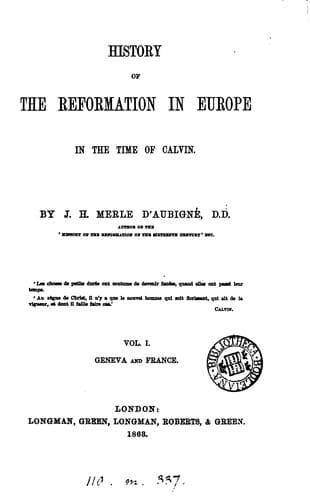
History of the Reformation in Europe in the Time of Calvin, Vol. 6 (of 8)Merle d'Aubigné, J. H. (Jean Henri)
History
History of the Reformation in Europe in the Time of Calvin, Vol. 6 (of 8)
Merle d'Aubigné, J. H. (Jean Henri)
Reformation
We have said that before Calvin’s arrival at Geneva, rules of
discipline were in existence and in force. There is here however
something new, as is evident from the language of the pastors. It is
_excommunication_. This is a point of great importance, for it was
on this subject that violent conflicts soon after began in Geneva.
It does not however appear, from the official records, that the
articles met with any opposition in the council. Surely a Christian
life and a Christian faith ought to characterize a Christian society.
If profligates and drunkards ought not to be admitted to what the
world calls good society, much more, they thought, ought they to be
excluded from a religious society. Moreover, they were _laymen_ of good
report who were to watch over moral order, and even those laymen were
appointed by other laymen, members themselves of the council. This
fact made a great difference between the Romish discipline and that
which the reformers desired. In this case there was no suggestion of a
reign of clericalism; and this doubtless contributed to the adoption
of the rules. Calvin was convinced that morality ought to distinguish
the reformed Church from the deformed (_l’église réformée de l’église
déformée_). Was it not dissolute living, both on the part of the laity,
and still more on the part of the monks and the priests, which had
called forth in the Church the sharpest rebukes? It was not possible
to purify the faith without purifying the life. That would have been
a flagrant contradiction. If the Reformation made light of morality,
it would destroy itself as Rome had done. With regard to doctrine, no
one supposed that the reformed Church could hold in its bosom either
Roman Catholics or pantheists who believed neither in God nor in the
immortality of the soul. Why then should it tolerate impure persons or
robbers? All this is true: but nevertheless there is something in the
system that does not work smoothly. Calvin was right, and he was wrong
too. We shall have to say wherein lay his truth and wherein his error.
Public-domain text, read in full here on John Shaqi.
Reviews
Reviews
No reviews yet
Be the first to share your thoughts on this work.
Elsewhere in the archive
Join the Discussion
Join the discussion
Sign in to leave a comment or review.
Sign InorCreate an account