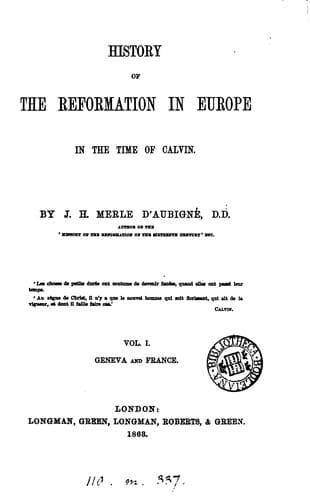
History of the Reformation in Europe in the Time of Calvin, Vol. 6 (of 8)Merle d'Aubigné, J. H. (Jean Henri)
History
History of the Reformation in Europe in the Time of Calvin, Vol. 6 (of 8)
Merle d'Aubigné, J. H. (Jean Henri)
Reformation
The articles presented to the senate dealt also with the spiritual
songs of the Church. If only the minister speak, worship remains cold:
but the singing ‘has power to raise our hearts to God,’ said Calvin,
‘and to stimulate us to exalt his name.’ He urged the education of
children, ‘in order to correct the wonderful rudeness and ignorance in
which they were left through the negligence of their parents, and which
is not by any means allowable in the Church of God.’ Then he treated
of the order of marriage, ‘a subject involved in much confusion by the
pope, who undertook to establish degrees at his own pleasure.’ Calvin
closed his articles with an eloquent exhortation to the council. ‘Take
not these admonitions,’ said he, ‘as coming from us, but from Him who
gives them in his Word. And should any one allege the difficulty of
putting them in practice, let it not trouble you; for we must cherish
the hope that whenever we are willing to do what God has commanded, His
goodness will prosper our enterprise and bring it to a good end, as you
yourselves have found by experience to this day.’
Calvin thus set about his task like a great master. A catechism which
bore at once the impress of genius and of piety: a confession of faith,
pure and living: a Church order which had for its aim the removal of
vice and the quickening of piety:--these formed the threefold labor
with which the illustrious reformer began his work.
[Sidenote: THE ARTICLES APPROVED.]
The articles, after being sanctioned by the lower council, were carried
the same day before the Council of the Two Hundred, and were allowed.
The council further decreed that no shops should be open on Sundays
during the time of divine service: that all persons who had images and
idols in their houses should destroy them or bring them to be burnt:
that no one should sing foolish songs nor play at games of chance: and
finally that the syndic Porral and Jean Goulaz should be commissioned
to see to the maintenance of good morals in the city, and that people
led lives conformed to the will of God.[460] The choice of Porral was
very good: that of Goulaz, who was personally no enemy to play or to
taverns, was not so good. The council showed by these measures with
what seriousness it meant to proceed in the accomplishment of the
Reformation. Soon after it adopted another resolution. Many children
of Geneva were sent away to various places and intrusted to foreign
governors. The council decreed, January 30, that those persons who had
children at schools not in Geneva, should have them brought into that
town or placed in other _Christian_ schools; that otherwise the said
children would be deprived of citizenship.[461] This was a rigorous
measure; but it shows what spirit actuated the council, and its zeal in
the cause of sound education.
Public-domain text, read in full here on John Shaqi.
Reviews
Reviews
No reviews yet
Be the first to share your thoughts on this work.
Elsewhere in the archive
Join the Discussion
Join the discussion
Sign in to leave a comment or review.
Sign InorCreate an account