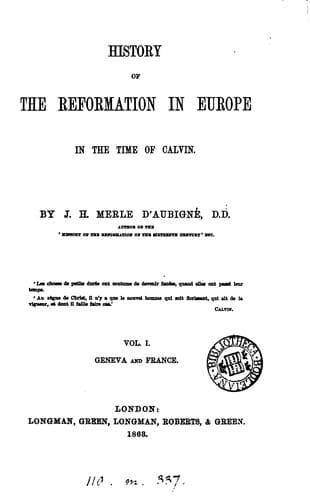
History of the Reformation in Europe in the Time of Calvin, Vol. 6 (of 8)Merle d'Aubigné, J. H. (Jean Henri)
History
History of the Reformation in Europe in the Time of Calvin, Vol. 6 (of 8)
Merle d'Aubigné, J. H. (Jean Henri)
Reformation
One single fact
appears to indicate that women were present. On September 28, 1537, the
council dealt with the case of _Jeanne la Gibescière_, who would not
swear to the new reformation, and banished her on that account. But
more than a month earlier, on August 21, this same Jeanne, belonging
to a particular sect (_the Spirituals_), on its being proposed to
her to swear to the new reformation, had refused to do so, and had
consequently been placed under arrest. That case, therefore, cannot be
alleged as an absolute proof that women also swore to the confession at
St. Peter’s.
[Sidenote: CONVOCATION OF THE PEOPLE.]
Accordingly, on Sunday, July 29, the council assembled in the
cathedral, and the tithings passed in successively. Young people who
had attained their majority, and old men with white hair, perhaps women
as well as men, came forward. Rozet, secretary to the council, read the
confession of faith. Next came the oath of fidelity and obedience,
which each in his turn took by lifting up his hand.[469] ‘The people,’
says Calvin, ‘show no less alacrity in taking the oath than the senate
had shown diligence in publishing it.’[470] A large number of the
Genevese professed with all their heart the evangelical doctrines.
Nevertheless, the opinion of Saunier might be supported by weighty
reasons. If he was opposed to the imposition of a personal engagement,
it was because he knew that the confession was not the exact expression
of the faith of each individual; that some of those who would swear to
it did not understand it either wholly or in part; and that others,
while understanding it better, had only an intellectual belief, which
might fail when assailed by captious objections. Individuality did
not appear to be at that time adequately respected. But the public
profession of faith of July 29 had been so solemn a proceeding that
many rejoiced at it. There were however many people who abstained from
joining in it, because they were still attached to Roman Catholicism.
There were also a certain number who were unwilling to submit to moral
discipline. George Lesclefs and his servant said that they could not
bring their minds to swear to keep the ten commandments, because they
were so difficult.[471] Others refused to take the oath from a spirit
of political independence.
Nevertheless, we may assert in a general way that the people gave
their adhesion to the confession; and that was a glorious day for the
Reformation on which those hands were lifted up for the Gospel in the
old cathedral of St. Peter. The sky, indeed, was afterwards clouded,
but that day was clear and serene.
[Sidenote: THE OATH REFUSED BY MANY.]
Public-domain text, read in full here on John Shaqi.
Reviews
Reviews
No reviews yet
Be the first to share your thoughts on this work.
Elsewhere in the archive
Join the Discussion
Join the discussion
Sign in to leave a comment or review.
Sign InorCreate an account