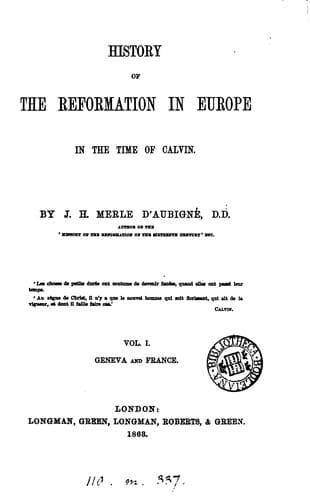
History of the Reformation in Europe in the Time of Calvin, Vol. 6 (of 8)Merle d'Aubigné, J. H. (Jean Henri)
History
History of the Reformation in Europe in the Time of Calvin, Vol. 6 (of 8)
Merle d'Aubigné, J. H. (Jean Henri)
Reformation
Calvin, indeed, was not content with the mere
instruction of the Genevese in accordance with the confession. It
would have sufficed Saunier, who saw with regret, at least at this
time, that adhesion to the formula of the confession was required of
every Genevese.[467] But it was not enough for Calvin that the document
should be officially recognized by the council as an expression of the
faith of the Genevese, a course which had been deemed satisfactory in
other places. He demanded that each individual should accept it. He
did not believe that the state was in this case responsible for the
people. Every Genevese was responsible before God. He did not want
religion in the mass. Does not Christ say, _Whosoever shall confess me
before men_? Whosoever--that is, each individual. This is perfectly
true; but the mistake is to suppose that, in order to confess Christ,
it is necessary to sign a theological confession. ‘If thou believest
in thy heart, thou shalt be saved,’ says Paul. We are reminded of a
poor woman who desired participation at the supper, and whose pastor
subjected her to an examination on the three offices of Christ, as
prophet, priest, and king. ‘Ah, sir,’ she replied, ‘I know nothing
of those things, but I am ready to die for him.’ ‘That will do,’
said the minister, with some sense of shame. Theology is necessary
to theologians; it must not be demanded of simple folk. The three
leading ministers, Farel, Calvin, and Courault, the latter blind and
old, being of the same mind on the subject, appeared before the Two
Hundred, presented their formula, and earnestly pressed the council to
give glory to God by confessing His truth. ‘It is right,’ said Calvin,
‘that in so sacred a duty you, who are bound to set an example of all
virtue, should go before the people.’ But that was not enough for him.
‘Then,’ he added, ‘assemble the country by tithings, and let every man
swear to this confession.’[468] The council adopted the views of the
reformer, which Saunier himself had embraced. All the tithing men were
summoned to give first their own adhesion; and the council charged them
to exhort those over whom they were set to follow the commandments of
God, and to bring their men (_leurs gens_) to St. Peter’s, tithing
by tithing (there were twenty-eight of them), to adhere to the
confession. The adhesion was given through the medium of the tithing
men, successively, and not simultaneously. A principle, from which
there was no deviation, excluded women from the general council. But in
this instance the assembly was of a religious rather than a political
character. It was well known how great the influence of woman is in
the family as regards religion. It is therefore possible that both men
and women were summoned together to St. Peter’s, distributed in groups
by their tithing men. The decree which we have just cited directs them
to bring their _gens_, a word which may include both sexes. However,
we have found no positive evidence on this point.
Public-domain text, read in full here on John Shaqi.
Reviews
Reviews
No reviews yet
Be the first to share your thoughts on this work.
Elsewhere in the archive
Join the Discussion
Join the discussion
Sign in to leave a comment or review.
Sign InorCreate an account