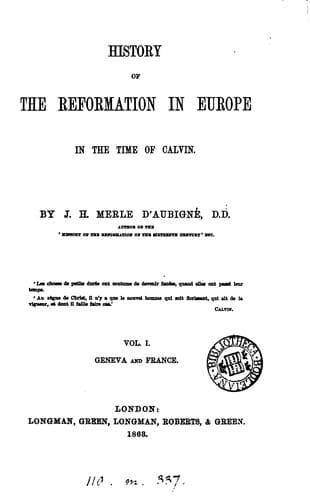
History of the Reformation in Europe in the Time of Calvin, Vol. 6 (of 8)Merle d'Aubigné, J. H. (Jean Henri)
History
History of the Reformation in Europe in the Time of Calvin, Vol. 6 (of 8)
Merle d'Aubigné, J. H. (Jean Henri)
Reformation
The reformer was struck with astonishment. ‘It had never entered into
my imagination,’ he wrote, ‘that we had to fear being accused on this
point.’[502] Calvin perceived the scope of the attack which Caroli had
just made. If he were to remain under this charge, his ministry would
be compromised, his zeal suspected, his labors fruitless. Discord would
be thrown into the evangelical camp, and Rome exult to see the most
devoted champions of the Reformation accused of denying the divinity of
the Saviour. The reformer immediately rose; and without any exhibition
of violence, with which his enemies are always ready to reproach him,
he pointed out with much spirit the inconsistency of his opponent.
‘Only a few days ago,’ he said, ‘Caroli invited me to his table. I was
at that time a _very dear brother_. He bade me present his compliments
to Farel; he treated as Christians all those whom he looks on to-day as
heretics, and protested that he wished to maintain for ever a brotherly
union with us. Where, at that time, was the glory of God, where the
purity of the faith and the unity of the Church?’ Then, turning towards
the doctor of the Sorbonne--‘How could you,’ he said, ‘conscientiously
celebrate the holy supper on two occasions with an Arian associate?
From what source have you learnt that I am tainted with that heresy?
Tell me, for I will clear myself of that infamy.’ As Caroli brought
forward no evidence, the reformer appealed to the catechism which he
had recently published. ‘This is the faith,’ said he, ‘which I have but
lately professed. We confess that we believe in the Father, in the Son,
and in the Holy Spirit; and when we name the Father, the Son, and the
Spirit, we do not imagine to ourselves three gods. But we believe that
Scripture and the experience of piety show us the Father, the Son, and
the Spirit in simplest divine unity.’[503]
Public-domain text, read in full here on John Shaqi.
Reviews
Reviews
No reviews yet
Be the first to share your thoughts on this work.
Elsewhere in the archive
Join the Discussion
Join the discussion
Sign in to leave a comment or review.
Sign InorCreate an account