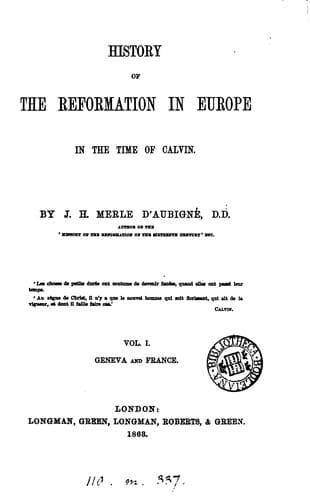
History of the Reformation in Europe in the Time of Calvin, Vol. 6 (of 8)Merle d'Aubigné, J. H. (Jean Henri)
History
History of the Reformation in Europe in the Time of Calvin, Vol. 6 (of 8)
Merle d'Aubigné, J. H. (Jean Henri)
Reformation
Caroli was not by any means satisfied. The words in his view essential
were missing. Calvin thought it advisable, in works of a practical and
popular character, to avoid the use of expressions which are not found
in holy Scripture. Therefore he had avoided the use, in the passage
cited, of the terms _Trinity_, _substance_, or _persons_. Luther had
done the same. ‘This term, _Trinity_,’ said he, ‘is nowhere to be
found in holy Scripture; it was invented by men. Moreover the word
is frigid, and it is far better to say _God_ than _Trinity_.’[504]
Calvin, who was full of spirit and life, was afraid that by the use of
these theological terms Christianity should be placed solely in the
understanding of the man and of the child, and not in his conscience,
his heart, his will, and his works. He had employed them the year
before in the first edition of his _Institution_, which was intended
for professed theologians:[505] but he had excluded them both from his
_Confession_, prepared chiefly for the laity, and from his _Catechism_,
composed for children. All this did not pacify Caroli, who, if he was
orthodox, was only orthodox in the head. He alleged that if Calvin
was innocent of Arianism, he was guilty of Sabellianism. ‘You will be
under suspicion on that matter,’ said he, ‘until you have subscribed
the Athanasian creed.’ ‘My practice,’ replied Calvin, ‘is not to
approve of anything as in conformity with the Word of God until after
due consideration.’ Caroli, thinking that the Athanasian creed was
compromised by this reserve, flew into a passion and cried out, ‘that
this avowal was unworthy of a Christian.’[506]
[Sidenote: CONVOCATION OF A SYNOD.]
Up to this moment Calvin had restrained himself; but he felt deeply
the injustice of the doctor’s accusations. When he had received an
unmerited blow, he not seldom replied by striking another himself. The
blow was just, but sometimes rather sharp. ‘You will not find any one,’
he said to Caroli, ‘more earnest than I am in maintaining the divinity
of Jesus Christ. I think that I have given a sufficiently clear account
of my faith. My works are in everybody’s hands, and all the orthodox
churches approve my doctrine. But as for you, what evidence have
you ever given of your faith, except possibly in public-houses and
the haunts of vice? For it is in such places that you have hitherto
practised.’
Public-domain text, read in full here on John Shaqi.
Reviews
Reviews
No reviews yet
Be the first to share your thoughts on this work.
Elsewhere in the archive
Join the Discussion
Join the discussion
Sign in to leave a comment or review.
Sign InorCreate an account