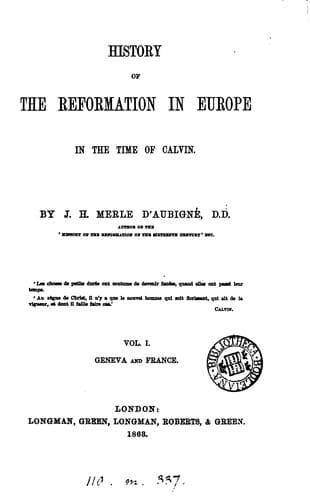
History of the Reformation in Europe in the Time of Calvin, Vol. 6 (of 8)Merle d'Aubigné, J. H. (Jean Henri)
History
History of the Reformation in Europe in the Time of Calvin, Vol. 6 (of 8)
Merle d'Aubigné, J. H. (Jean Henri)
Reformation
Calvin listened to him without interrupting him; but he could no longer
keep silence. A justification on his part was almost superfluous. He
had fully professed the doctrine in his popular writings; he had even,
as we have seen, employed the terms of the school in his theological
_Institution_. But the point of importance for the safety of the Church
was to make his adversary known, to tear the mask from his face. That
man, of dissolute life, destitute of convictions, destitute of faith,
whose only thought was how to get possession of the highest place,
and who was endeavoring to conceal the licentiousness of his evil life
under the pretence of religion, dared to accuse, with hypocritical
lips, the faithful servants of God. A course so revolting roused
Calvin’s indignation; and from his lips fell such earnest words as
were inspired by the fraud, the vices, and the shamelessness of his
adversary. He completely stripped the man. ‘What wickedness this is,’
said he, ‘without any cause but mere lawless passions, to disturb the
Church and to check the progress of the Gospel by bringing atrocious
accusations against persons entirely innocent, who have rendered the
most conspicuous services to the truth! Caroli sets up a quarrel with
us about the distinction of the persons in God. I am going to examine
him in turn, but I take up the subject at a higher point, and I ask
him if only he believes in God. I declare before God and before men,
that he has no more faith in the divine Word than the dog and the swine
that trample under foot holy things.’ Some will perhaps exclaim against
this language, but it must be remembered that Calvin took these two
words from holy Scripture, where they are used to mark two different
characters, of both of which we must equally beware.[517] ‘Give not
that which is holy unto the dogs,’ said Jesus, ‘neither cast ye your
pearls before swine.’ The swine represent men defiled by debauchery,
and the dog is the beast that barks, pursues, and bites. These two
kinds of excess precisely characterized Caroli.
But Calvin did not stop there. He did not mean that people should be
able to say that the ministers were not cleared of the charges brought
against them. He therefore made a confession which had been beforehand
approved by his colleagues. ‘When we distinguish the Father, his
eternal Word, and his Spirit,’ said he, ‘we believe, in common with
ecclesiastical writers, that in the simple unity of God there are
three hypostases or substances, which, although they be one sole and
identical essence, are nevertheless not confounded with each other.
With respect to Jesus Christ,’ he added, ‘before taking on himself our
flesh, he was the eternal Word, begotten of the Father before time was,
very God, of one same essence, power, and majesty with the Father,
Jehovah himself, who has ever existed of himself, and gives to others
the property of existing.’[518]
[Sidenote: CALVIN AND THE EARLY CREEDS.]
Public-domain text, read in full here on John Shaqi.
Reviews
Reviews
No reviews yet
Be the first to share your thoughts on this work.
Elsewhere in the archive