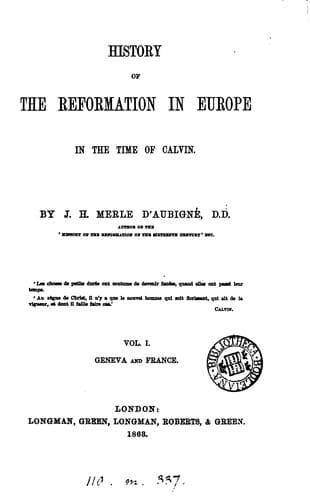
History of the Reformation in Europe in the Time of Calvin, Vol. 6 (of 8)Merle d'Aubigné, J. H. (Jean Henri)
History
History of the Reformation in Europe in the Time of Calvin, Vol. 6 (of 8)
Merle d'Aubigné, J. H. (Jean Henri)
Reformation
This declaration baffled Caroli; and now, after having very strongly
asserted that Calvin was not orthodox enough, he began to cry out that
he was too much so. ‘What,’ said he, ‘you attribute to Jesus Christ
the name and the nature of Jehovah; you say that he has of himself
the divine essence!’ Calvin replied, ‘If we attentively consider
the difference between the Father and the Word, we must acknowledge
that the Word proceeds from the Father. But if we concern ourselves
with the essence itself of the Word, so far as the Word is God with
the Father, all that is said of the one must likewise be said of the
other.’[519] Caroli, giving up the matter, took refuge in the words.
‘In your confession,’ said he, ‘there is not the word _Trinity_, there
is not the word _person_.’ Then, wishing to compel Calvin and the other
ministers to adopt the confessions made by men,--‘I demand,’ said he,
‘that you sign the three ancient creeds.’ Calvin and the ministers
who were with him would have given their signature under other
circumstances, but they now refused it for very wise reasons. ‘Caroli,’
they said, ‘by compelling us to sign, wishes to throw suspicion on our
faith. We do not consider it fitting to show him so much deference.
Moreover, we will not, by our example, promote the introduction into
the Church of a _tyranny_ which would brand every man as a heretic who
will not express himself in terms dictated by another.’[520] Herein
Calvin gave proof at the same time of a magnanimity and a fidelity
which do him honor. Every Church, in his opinion, ought to confess its
doctrine, but he would rather that the confession should be the product
of the life and the faith of those who make it; and not a mere return
to ten or twelve centuries back, in order to seek the truth in the
antiquated phrases of another age. He professed with all his heart the
doctrine enunciated in the early creeds, the Nicene and the so-called
Athanasian, which set forth, perhaps with superfluity of words, but
nevertheless with much force, a faith which is dear to Christian men.
But he felt that these writings were wanting in evangelical simplicity.
The phrases ‘God of God, Light of Light’ (Θεὸς ἐκ Θεοῦ, Φῶς ἐκ Φωτὸς),
used in the Nicene creed, appeared to him less apostolic than Oriental
in their character. It shocked him that the _Quicunque_, better known
under the name of the Athanasian creed, just at the time when it is
going to make subtle distinctions, such as the faith of a simple
Christian man cannot comprehend, should begin by asserting--‘Whosoever
will be saved, before all things it is necessary that he hold the
Catholic faith (that of the creed). Which faith, except every one do
keep whole and undefiled, without doubt he shall perish everlastingly.’
Caroli’s ignorance as to this profession of faith was so great that
he believed it was drawn up at Nicæa in A.D. 325, and by
Athanasius. This was startling to Calvin. The creed appears, in
Public-domain text, read in full here on John Shaqi.
Reviews
Reviews
No reviews yet
Be the first to share your thoughts on this work.
Elsewhere in the archive
Join the Discussion
Join the discussion
Sign in to leave a comment or review.
Sign InorCreate an account