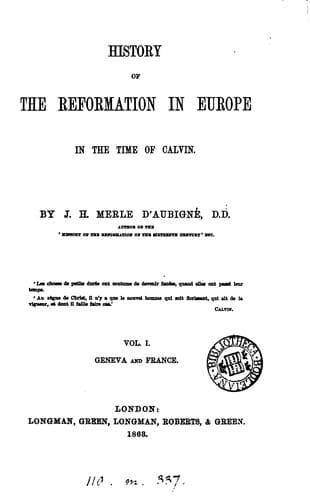
History of the Reformation in Europe in the Time of Calvin, Vol. 6 (of 8)Merle d'Aubigné, J. H. (Jean Henri)
History
History of the Reformation in Europe in the Time of Calvin, Vol. 6 (of 8)
Merle d'Aubigné, J. H. (Jean Henri)
Reformation
The synod, having heard both parties and maturely considered the
matter, acknowledged the confession of the Genevese ministers to
be good and orthodox; and they condemned Caroli, and declared him
henceforth unworthy to fulfil the functions of the ministry. ‘We
have, by our refutation,’ said Calvin, ‘exhausted all that bag of
Caroli’s;[522] with regard to ourselves there now remains not the
slightest suspicion.’ Caroli appealed from the sentence of the synod
to the lords of Berne. Who was right? Who was wrong? Calvin or
Caroli? Judgments have differed on the point. Some have said, ‘The
denunciation by Caroli was not altogether unfounded; it is no wonder
that he declared himself dissatisfied and maintained his charge.’
Others have added that Calvin fell on his adversary with a violence
which made the assembly tremble, and which afforded the first instance
of that fearful anger with which so often afterwards he struck down
those who were against him.[523] This is not our opinion. As to his
expressions, Calvin’s defence is not so terrible, so passionate, if we
call to mind the sort of man with whom he had to deal; and as for the
hardest words of the reformer, they are, as we have seen, two which he
adopted from the Saviour himself. As to the substance of the defence,
he would not bring forward, as Roman Catholics do, human authorities;
he preferred to hold fast to the Word of God. That is his chief glory,
and therein does he show himself a genuine reformer, as Luther did. His
adversary was an immoral character, and the Reformation would make no
covenant with immorality. Who would blame him for that? Calvin could
not consent that a dissolute man, whose hand was stained with the
blood of the saints, should pass for an Athanasius, one of the noblest
of the ancient doctors of the Church. He was, above all, profoundly
afflicted by the thought that the blow struck by that man was shaking
the foundations of the spiritual building which was being erected to
the glory of God.
These debates made a great noise in other lands. All kinds of rumors
were current at a distance, and evil reports were circulated about the
Genevese reformers. People were asking one another what this contest
between Caroli and Calvin was about, and they waited impatiently for
the issue of it. French vivacity had been offensive to some theologians
of German Switzerland. Megander himself complained to Bullinger of the
annoyance which those turbulent Frenchmen had caused him.[524] People,
however, were as easily agitated in German Switzerland, and even in
the land of Luther. Some Catholics began to attach importance to these
struggles, and to take advantage of them. Letters were exchanged on
the subject. Bucer and Capito wrote from Strasburg, the former to
Melanchthon, the latter to Farel; and Myconius wrote from Basel to
the assembly itself. This must needs invest with more solemnity the
judgment on the appeal which was about to be heard at Berne.
Public-domain text, read in full here on John Shaqi.
Reviews
Reviews
No reviews yet
Be the first to share your thoughts on this work.
Elsewhere in the archive
Join the Discussion
Join the discussion
Sign in to leave a comment or review.
Sign InorCreate an account