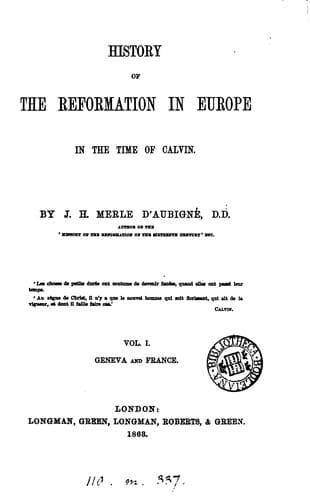
History of the Reformation in Europe in the Time of Calvin, Vol. 6 (of 8)Merle d'Aubigné, J. H. (Jean Henri)
History
History of the Reformation in Europe in the Time of Calvin, Vol. 6 (of 8)
Merle d'Aubigné, J. H. (Jean Henri)
Reformation
‘On May 24, Guillaume Farel requested of the council of Geneva to send
to that city Master Cauvin (Calvin) for any battle (_journée_) there
was to be, to take part in the disputation. Upon which it was resolved
that he should go.’[525] Berne had shown a certain favor towards
Caroli. It might therefore be feared that the judgment pronounced at
Lausanne would not be confirmed. We cannot tell what the sentence would
have been if it had been pronounced by the state authorities. But the
council, finding that it was a question of doctrine, had convoked at
Berne the synod of the Bernese Church for the end of May. The debate
was opened in the presence of the great council, which doubtless took
part so far in the cause. The would-be Athanasius supported his charge
with confidence and a haughty spirit, assuming to play in the sixteenth
century the part which the great bishop of Alexandria had played in the
fourth. Calvin completely justified both himself and his colleagues.
Consequently the reformer was once more entirely acquitted, and
declared free not only from all fault but also from all suspicion. As
for Caroli, he was pronounced a slanderer, and as such condemned.
[Sidenote: CONDEMNATION OF CAROLI.]
When that was over, the lords of Berne inquired of Calvin, Farel, and
Viret whether Caroli was, so far as they knew, guilty in any respect,
either in his private life or especially in his ministry. As soon as
he heard these words, the doctor of the Sorbonne, seeing that his own
turn was come, was terror-struck, and vehemently opposed the inquiry.
‘Those whom I have just accused of great crimes,’ said he, ‘cannot be
allowed to bring formal charges against me.’ ‘You have indeed accused
them,’ replied the Bernese, ‘and without being able to substantiate
your charges. Why then should they not be allowed to accuse you?’ And
the doctors were enjoined to communicate anything they knew with regard
to him. Thereupon this man, who had no heart, no moral sentiment,
was disconcerted; and as he dreaded above all the revelations of his
adversaries, he fancied that the best way to avert them was to accuse
himself. He began therefore to confess the faults with which he knew
that Farel and his friends were well acquainted--the debaucheries to
which he had addicted himself in France, the meanness with which he had
dissembled his sentiments in matters of religion, and the cruel perfidy
which had prompted him to deliver to death two young Christians whose
way of thinking he himself approved. It was a strange sight! Here was a
singular penitent, without repentance and without scruple, assuming a
contrite air and confessing his faults solely because he hoped in that
way to secure exemption from punishment. ‘A devil’s penitent!’ said
Tertullian in such cases.
Public-domain text, read in full here on John Shaqi.
Reviews
Reviews
No reviews yet
Be the first to share your thoughts on this work.
Elsewhere in the archive
Join the Discussion
Join the discussion
Sign in to leave a comment or review.
Sign InorCreate an account