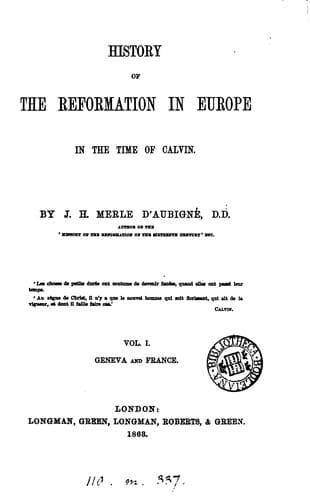
History of the Reformation in Europe in the Time of Calvin, Vol. 6 (of 8)Merle d'Aubigné, J. H. (Jean Henri)
History
History of the Reformation in Europe in the Time of Calvin, Vol. 6 (of 8)
Merle d'Aubigné, J. H. (Jean Henri)
Reformation
Farel had let him speak; nevertheless he did not think that he was
thereby discharged from the injunction which had been given him. He
was acquainted with certain traits of Caroli’s life which might give
the lords of Berne the intelligence of which they were in need. He
narrated the shameful licentiousness of the man, who had lived at Paris
with women of the vilest reputation, and had actually been accused of
keeping five or six at a time. He showed how two young men, carried
away by their zeal against images, had taken it into their heads to
hang some of them; and how that same Caroli, who at that time professed
that the worship of images diverts men from the knowledge of the true
God, had caused these youths to be kept in the prison into which they
had been cast until two judges arrived, who had them delivered over to
the executioners. Viret related the discussion which he had held with
Caroli on the subject of prayers for the dead; and, at the request of
the Bernese, reported various details of his conduct, among others his
drunkenness, which had more than once exposed him to the derision of
the public.
[Sidenote: BERNE PROMOTES THE REFORMATION.]
In consequence of these debates, Caroli was deprived of his functions
by the synod. The great council of Berne confirmed this sentence;
pronounced Farel, Calvin, and Viret innocent of the charges brought
against them; condemned Caroli to banishment as guilty of slander
and other excesses; and remitted the cause to the consistory to be
formally terminated. As the presumptuous doctor was unwilling to
submit to that authority, the parties were summoned before the civil
magistrates (_avoyers_) and the councils. Calvin, Farel, and Viret
accordingly presented themselves, June 6, but Caroli did not appear.
An usher, sent by the lords of Berne to seek him, brought word that he
had disappeared.[526] He had in fact fled early in the morning, and had
taken the road to Soleure. From that place he withdrew into France, to
the cardinal of Tournon, the great enemy of the Reformation. The latter
obtained absolution for Caroli from the pope. The wretched man had
hoped that, by returning into the Roman Church, he should get a good
benefice; but he found that he was held in equal contempt by Catholics
and Protestants. To close the affair, it was agreed to approve the
terms Trinity, substance, and persons (Calvin himself had made use of
them); but at the same time that if any pious man declined to employ
them, ‘he should not be cast out of the Church, nor should be looked on
as one who thought wrongly as to the faith.’[527]
This episode in Calvin’s life shows us not only his firm attachment
to the truth, which everyone acknowledges, but likewise a spirit of
freedom which is ordinarily denied to him. It is clear that with
him the Word of God stood before all, and that the faith, the life,
and essence of Christianity had more value in his eyes than mere
traditional terms, which are not to be found in the Scriptures.
Public-domain text, read in full here on John Shaqi.
Reviews
Reviews
No reviews yet
Be the first to share your thoughts on this work.
Elsewhere in the archive
Join the Discussion
Join the discussion
Sign in to leave a comment or review.
Sign InorCreate an account