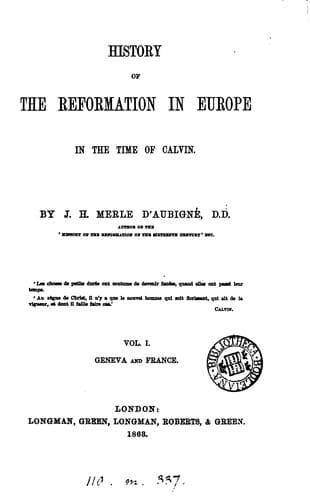
History of the Reformation in Europe in the Time of Calvin, Vol. 6 (of 8)Merle d'Aubigné, J. H. (Jean Henri)
History
History of the Reformation in Europe in the Time of Calvin, Vol. 6 (of 8)
Merle d'Aubigné, J. H. (Jean Henri)
Reformation
The Bernese magistrates, however, were not willing to break with their
allies. The war against Savoy, which they had undertaken in 1536,
for the defence of Geneva and the occupation of the Pays de Vaud,
had convinced them of the need of their support. Consequently, they
sent delegates to the four colloquies which were held that same year
at Basel, to take into consideration the agreement with the doctors
of Wittenberg. But the council, so far from breaking with Megander,
put him at the head of these theologians. So the confession which was
prepared at the first of these colloquies, in January 1536 (the second
conference of Basel and the first of Switzerland,) when speaking of
eating the body and drinking the blood of Christ, added that this
took place only in a spiritual sense. This displeased Bucer. The
Zwinglians, in turn, called him ‘a doubled-faced man,’ and said that
this pretended peacemaker brought division into the Helvetic Churches.
It was to no purpose that his defence was undertaken by Myconius, who,
since 1532, had presided as overseer of the Church at Basel, and the
learned professor Grynæus. The Zwinglian party would not hear a word
about an agreement with the _Strasburg trimmer_. Various circumstances
occurred to bring about a change in this state of things. The Swiss
and the Bernese themselves were touched by the beautiful letter which
Luther had written to the burgomaster of Basel, in which he spoke
approvingly of the confession drawn up in that city. The aged Kolb,
pastor of Berne, had died at the end of 1535; and on February 25,
1536, Haller also had passed into the unseen world. A great change
then took place in Berne. Kunz, a man of a very different spirit from
Zwingli and Haller, became pastor in the place of Kolb. Having studied
at Wittenberg, he was a passionate admirer of Luther and of his
doctrine. Of ardent temperament, Kunz longed to promote the triumph of
his master’s doctrine, and so much the more as he was his inferior in
respect to the living faith of the Gospel. Sebastian Meyer, a former
Franciscan, who from the beginning of his ministry had been remarkable
for the violence of his discourses, and who was a friend of Bucer, had
taken the place of Haller. The council had probably been influenced in
the election of these men by the Strasburg doctors, with whose projects
the members were more and more pleased. Thus it seemed likely that in
Berne the Lutheran party would succeed the Zwinglian. The new pastors,
however, did not immediately set up their claim; they rather applied
themselves to the preparation of men’s minds, and their conquests
were very numerous, especially among politicians. But Megander, the
inflexible Zwinglian, still kept the upper hand; and it was he who
spoke in the name of Berne in the Swiss assemblies. Bucer, doubtless,
had him in mind when he complained to Luther ‘of those untractable
heads which are found in Switzerland, which for every trifle make so
much ado.’[530]
Public-domain text, read in full here on John Shaqi.
Reviews
Reviews
No reviews yet
Be the first to share your thoughts on this work.
Elsewhere in the archive
Join the Discussion
Join the discussion
Sign in to leave a comment or review.
Sign InorCreate an account