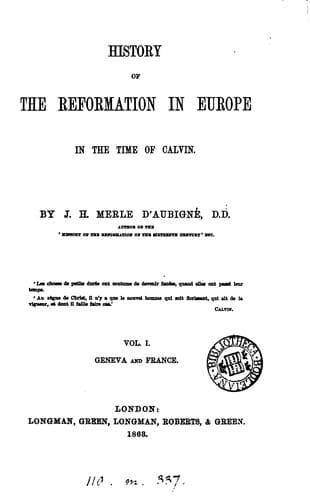
History of the Reformation in Europe in the Time of Calvin, Vol. 6 (of 8)Merle d'Aubigné, J. H. (Jean Henri)
History
History of the Reformation in Europe in the Time of Calvin, Vol. 6 (of 8)
Merle d'Aubigné, J. H. (Jean Henri)
Reformation
[Sidenote: A PATCHED-UP PEACE.]
The new pastors of Berne, encouraged by their friends abroad, threw
off the restraint which they had at first imposed on their speech.
Sebastian Meyer, in particular, giving way to his natural disposition,
thoroughly headlong and incautious, taught publicly that in the supper
the body of Christ is truly eaten and his blood truly drunk, but took
care to add, _by faith_. Kunz supported him. The conflict thus began.
Megander and Erasmus Ritter started up to oppose this doctrine; and
Meyer did not hesitate to say in the colloquies that the doctrine of
the supper had never been rightly taught in the canton of Berne. The
Bernese council convoked a synod, at which three hundred ministers
of the German and French cantons of Switzerland were present. Meyer,
together with Kunz, vividly depicted the evils which would be involved
in a rejection of the agreement. Erasmus Ritter, with Megander, replied
that an agreement was certainly very much to be desired, but that the
truth must not be sacrificed to it. The Zwinglian party had the best
of it. They agreed to stand by the second confession of Basel, and to
avoid the use of terms which gave origin to the disputes; such as,
_corporal_, _real_, _natural_, _supernatural_, _invisible_, _carnal_,
_miraculous_, _inexpressible presence_. But this patched-up peace was
of short duration. The secret correspondence between Bucer and Luther
having been published, the Zwinglians were scandalized, people’s minds
were thrown into agitation, and the edifice of concord, which they had
toiled to rear, threatened to crumble away. Bucer then applied to the
council of Berne, and requested it to convoke a synod at which he might
be allowed to vindicate himself. ‘This whole business of the supper,’
said he, ‘is a mere dispute about words, but it is of the utmost
importance to put an end to it; and I appeal to the justice of the
Bernese magistrates, who cannot allow a man, whoever he may be, to be
condemned before he is heard.’ Another synod was consequently convoked
at Berne, for the month of September.[531]
Public-domain text, read in full here on John Shaqi.
Reviews
Reviews
No reviews yet
Be the first to share your thoughts on this work.
Elsewhere in the archive
Join the Discussion
Join the discussion
Sign in to leave a comment or review.
Sign InorCreate an account