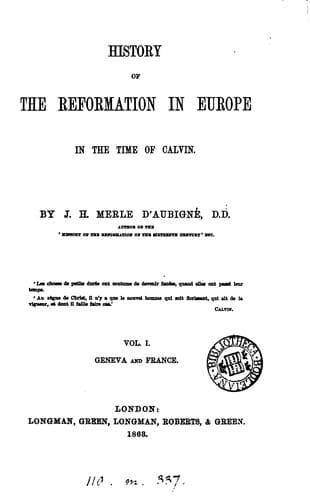
History of the Reformation in Europe in the Time of Calvin, Vol. 6 (of 8)Merle d'Aubigné, J. H. (Jean Henri)
History
History of the Reformation in Europe in the Time of Calvin, Vol. 6 (of 8)
Merle d'Aubigné, J. H. (Jean Henri)
Reformation
We have already related the heroic struggles which had restored to
Geneva her freedom and her independence.[540] We did so, less on
account of their intrinsic interest than because they exercised a
powerful influence, whether for good or for evil, on the Reformation.
We have seen how political emancipation permitted and was favorable to
religious emancipation. We have now to observe the obstacles raised
up by those who, while they rejected popery, did not embrace the
Gospel. The Huguenots (that is, as our readers will recollect, the
name which was given to the partisans of the alliance with the Swiss
Confederation) were divided after Calvin’s arrival. Some of them were
friendly to and supported the Reformation; others pronounced themselves
against him, and opposed his work. The opposition did not consist
merely of men of the lowest rank, vulgar and dissolute. There were on
both sides, in the great national party, some generous characters,
some honorable citizens. Unfortunately, as the State and the Church
were at that time not only united but blended with each other, these
two parties were at the same time both right and wrong. The political
Huguenots were right with respect to the State, and in error respecting
the Church; and the evangelical Christians were right with respect
to the Church, and in error with respect to the State. To make the
confusion greater still, the true principles of Church and State were
at that period very little understood. Many of the eminent citizens
who had exposed themselves to famine, pillage, and death for the sake
of being free, who had resolved not to have for their master either
their bishop, or the Duke of Savoy, or the King of France, or even
Berne; who had marched in the van for the political emancipation of
Geneva; now asserted their right to enjoy in peace the liberty for
which they had so long fought. We have admired them in their heroical
struggles. We will not brand them in this new opposition. Politically
they were right. In a certain sense they were also right religiously.
The religion of Jesus Christ will not be imposed by force, and it
rejects all compulsion. In the attempt to establish itself in any town,
it refuses alike the intervention of the martyr-fires of the Holy
Office and the decrees of a council of state. Jesus Christ said, _Wilt
thou be made whole?_ This is not the place for an inquiry into the
aids which this will of man receives from on high: we hold simply to
the declarations of the Saviour, and we say that man ought to feel the
want of the Gospel, and if he does not want it, no one has any right
to impose it on him. To act as the syndics then did was to ignore the
divine spirituality of the kingdom of God, and to make of it a human
institution. Another motive may possibly have contributed to arouse
opposition. Farel, Calvin, Courault, Saunier, Froment, and Mathurin
Cordier were foreigners, Frenchmen. They had drawn around them their
Public-domain text, read in full here on John Shaqi.
Reviews
Reviews
No reviews yet
Be the first to share your thoughts on this work.
Elsewhere in the archive
Join the Discussion
Join the discussion
Sign in to leave a comment or review.
Sign InorCreate an account