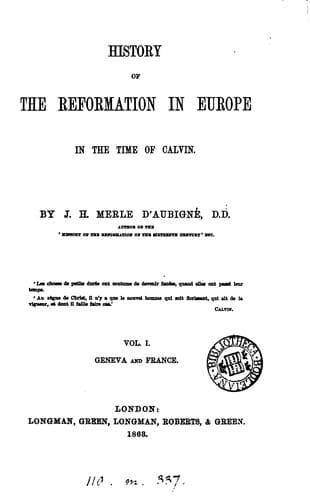
History of the Reformation in Europe in the Time of Calvin, Vol. 6 (of 8)Merle d'Aubigné, J. H. (Jean Henri)
History
History of the Reformation in Europe in the Time of Calvin, Vol. 6 (of 8)
Merle d'Aubigné, J. H. (Jean Henri)
Reformation
was suspected of holding the same views, having been exhorted by the
pastors and the magistrates, declared that his doubts about baptism had
vanished, and took an oath, says the Register, ‘to live as we do.’[539]
On October 5, Farel and Calvin announced that they would administer the
supper, but ‘that there were some who kept aloof, holding the opinions
of Benoît and Herman; and others who still kept their beads, which are
implements of idolatry.’ Thereupon the council determined ‘to take away
all the beads.’ That was far easier than to take away the faith of
which the beads were a sign.
[Sidenote: PARTIES AT GENEVA.]
Nothing could check the zeal of Calvin. On October 30 he presented
himself to the council, and set forth various grievances. ‘The
hospital,’ he said, ‘is very poorly furnished, and the sick are
suffering in consequence. Geneva has a Christian school, and
nevertheless some children go to the school of the papacy. Lastly it
is to be feared that dissensions will arise between the citizens, for
while some have taken the oath as to the manner of living, others have
not done so.’ The sick, the young, and peace among the citizens, these
were the matters which occupied the mind of the reformer, subjects well
worthy of his attention. The council decreed--‘The hospital shall be
supplied; all children shall be bound to go to the Christian school,
and not to the papistical; and the confession shall be required of all
who have not yet made it.’ This last point must inevitably be the most
difficult. A conflict was about to begin, and what would be its result?
We have just seen that there were in Geneva two parties, more or less
considerable, who set themselves in opposition to the evangelical
Reformation--the Roman Catholics and the Spirituals or Anabaptists.
But there was yet a third party, more respectable and therefore more
formidable. The Genevese people were naturally restless, and delighted
in freedom and in pleasure. At first they had warmly embraced the
Reformation, merely thinking that they should thereby be delivered from
their bishop and from the practices which they disliked. But as soon as
the Reformation demanded a Christian faith and life, the ardor of the
Genevese rapidly diminished. The severity of Calvin and his colleagues
chilled the violent ebullition of their zeal. They felt the ordinances
imposed on them to be troublesome and exorbitant. Moreover, it was not
only the jolly fellows, the lovers of pleasure and the libertines as
they are called, who were refractory. It would be a great mistake not
to acknowledge that in the ranks of the opposition there were other
motives and other men.
Public-domain text, read in full here on John Shaqi.
Reviews
Reviews
No reviews yet
Be the first to share your thoughts on this work.
Elsewhere in the archive
Join the Discussion
Join the discussion
Sign in to leave a comment or review.
Sign InorCreate an account