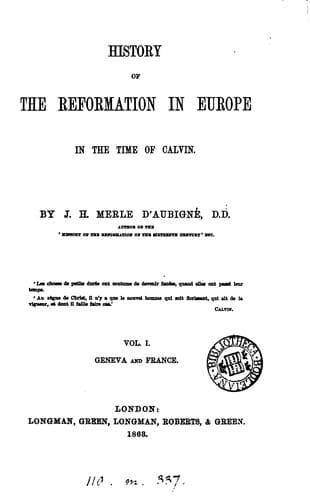
History of the Reformation in Europe in the Time of Calvin, Vol. 6 (of 8)Merle d'Aubigné, J. H. (Jean Henri)
History
History of the Reformation in Europe in the Time of Calvin, Vol. 6 (of 8)
Merle d'Aubigné, J. H. (Jean Henri)
Reformation
At length November 12 arrived. Each tithing man having called together
those of his quarter who had not yet taken the oath, they were
conducted to St. Peter’s in groups, tithing by tithing. The looks of
the people were fixed on these late comers. They were counted, but the
whole number was not large. Many did not come at all; ‘and likewise,
of those who lived in the Rue des Allemands, not one came.’[542] This
was a blow for the friends of the Reformation. The Rue des Allemands
(of the German Swiss) was chiefly inhabited by those who had early
declared themselves for liberty, and afterwards for the Reformation,
and who had adhered to the Helvetic confessions. When the Genevese
Catholics, March 28, 1533, had attacked this party by force of arms, it
was in the Rue des Allemands that the reformed were drawn up in order
of battle, five in a row. It was there that the most pious had said,
‘There is not one single drop of comfort assured to us except in God
alone.’ It was there that all had exclaimed, ‘Rather die than give way
a single step.’[543] And now, of all those who inhabited that street,
not a single man came! Doubtless some of them had already sworn to
the confession. But there were probably some also who objected to the
doctrine, and others who, like Desclefs, felt the divine commandments
too hard for them to pledge themselves to keep them. But what chiefly
repelled these Huguenots was the fact that an act was commanded which
they knew they were free to do or not to do. They were determined not
to bend under that yoke. After having dared all kinds of hardship for
the sake of winning their freedom, they did not intend that, when they
had gained it in the state, it should be snatched away from them in the
Church. They were more in the right perhaps than they imagined; for it
is hardly likely that they fully understood this great principle, ‘The
power of the magistrate ends at the point at which that of conscience
begins.’ The difficulty was still more increased by the circumstance
that ‘those who had refused to swear to the confession, whether
Catholics or Huguenots, were among the most influential persons in the
city.’ Such is the testimony of Rozet, the secretary of state, who is
assuredly a witness above suspicion. But the syndics and their council
were no more disposed to give way than their adversaries. They thought
that they had as much right to impose that act as to order a military
review. On the same day the council decreed ‘that those who will not
take the oath to the Reformation must go and dwell in some other place,
where they may live according to their fancy.’ Two days later the Two
Hundred confirmed the decree, expressing themselves somewhat bluntly,
‘that they must quit the city, since they will not obey.’[544] The
bow was tightly bent, and no one was willing to unbend it. The crisis
became more violent; a shock and a catastrophe were inevitable. The
only question was, who would be the victims.
Public-domain text, read in full here on John Shaqi.
Reviews
Reviews
No reviews yet
Be the first to share your thoughts on this work.
Elsewhere in the archive
Join the Discussion
Join the discussion
Sign in to leave a comment or review.
Sign InorCreate an account