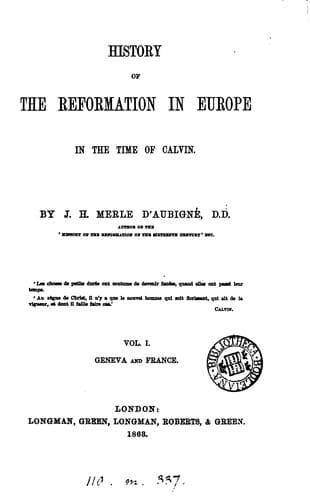
History of the Reformation in Europe in the Time of Calvin, Vol. 6 (of 8)Merle d'Aubigné, J. H. (Jean Henri)
History
History of the Reformation in Europe in the Time of Calvin, Vol. 6 (of 8)
Merle d'Aubigné, J. H. (Jean Henri)
Reformation
cried one of those who had been in prison with Sérais, Jacques Pattu,
‘yes, they brought Farel to prison and he told us that he would sooner
drink a glass of blood than drink with us.’ Scarcely had he let fall
these strange words, when Pierre Butini mounted on a bench and cried
out, ‘The franchise has been taken from us by the Porrets (Porral’s
friends), for we were seized, many good men, without informations and
without plaintiffs.’--‘I complain,’ resumed Pattu, ‘that they gave me
the halter without cause,’--‘I complain,’ said Sérais, further, ‘that
Claude Bernard told me that I would not go to hear Farel preach.’--‘Let
the others speak now!’ cried Baudichon de la Maisonneuve, annoyed at
Sérais beginning over again. But the friends of Sérais cried, ‘And we,
we will have Baudichon hold his tongue.’ Then Etienne Dadaz, resuming
the series of grievances, said, ‘I complain that I have been sent to
prison and accused of meaning to sell the town.’--‘Thou oughtest to be
silent,’ said the syndic Goutaz, ‘for thou hast brought from France
articles designed to make us subjects of the king.’ On which Dadaz
replied, ‘It is not I who made them, it is M. de Langey who gave them
me.’ This was certainly not justifying himself, for Langey was a
minister to the king.[547]
[Sidenote: CONFUSED COMPLAINTS.]
The most reasonable of the leaders saw that they must put a stop to
these turbulent complainings, which were ruining their interests. The
former syndic, Jean Philippe, a friend of freedom and courageous, but
also rash and leading a loose life, began to speak, and, addressing
the secretary of the council, Rozet, accused him of having caused the
confession to be sworn which he declared he had not sworn. This was not
escaping from the question, but plunging into it. This was the master
grievance of the opposition, and the matter to be investigated. ‘We
did ill to swear it,’ said Jean Lullin. ‘The ambassadors of Berne have
told us that we were perjured.’ De Chapeaurouge himself, who at first
had kept silence, getting enraged with the secretary of the council,
Rozet, who had caused the confession to be sworn, accused him of being
‘a witness of Susanna’ (that is to say, a false witness). ‘Gentlemen,’
said the respectable Rozet, with much feeling, ‘I have served you
long, and I have neither done wickedly nor borne false witness; and
here is De Chapeaurouge making me out to be a _witness of Susanna_!’
Chapeaurouge replied, ‘You told me, before the syndic Curtet, that
you had no conscience at all.’ Curtet answered, ‘I never heard that;’
and everyone began to laugh. Jean Philippe, a clever man, then made a
proposition which he thought likely to satisfy the opponents. He wished
to place the syndics under guardianship. ‘Gentlemen,’ he said, ‘it
would be a long task to listen in this place to all these plaintiffs
and to provide for them. It seems to me better that we should
choose, in general council, twenty-five men.’ These were twenty-five
Public-domain text, read in full here on John Shaqi.
Reviews
Reviews
No reviews yet
Be the first to share your thoughts on this work.
Elsewhere in the archive
Join the Discussion
Join the discussion
Sign in to leave a comment or review.
Sign InorCreate an account