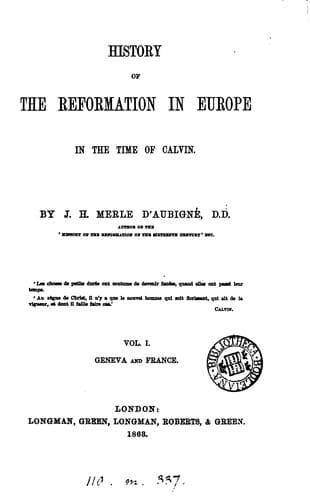
History of the Reformation in Europe in the Time of Calvin, Vol. 6 (of 8)Merle d'Aubigné, J. H. (Jean Henri)
History
History of the Reformation in Europe in the Time of Calvin, Vol. 6 (of 8)
Merle d'Aubigné, J. H. (Jean Henri)
Reformation
‘Come then, gentlemen, one after the other, peaceably to give your
opinion, _yes_ or _no_, in order that all things may be done well and
orderly, to the glory of God and our own great benefit.’[546]
One might have expected that, after this declaration, the leaders of
the opposition, De Chapeaurouge and his adherents, would state in
due form their alleged grievances. They remained silent. This was an
acknowledgment that their accusation was unfounded. They would have
found it difficult to assert that the election of the magistrates had
been due to the intrigues of a few individuals, in the presence of the
people who had themselves made that election freely and honorably.
Moreover, ten weeks only had to elapse before the regular renewal of
the council; and the opposition did not think that they ought to unmask
their batteries so long beforehand. It would be better to employ the
time in preparing the change which they wished to bring about. Thus,
therefore, after the address of the syndics there was a long silence.
After some time De Chapeaurouge rose; but instead of speaking as a
tribune who seeks to draw the people after him, he made a remark on
acoustics; ‘We cannot hear well,’ said he, ‘the place gives a dull
sound.’ There are none so deaf as those who will not hear. In fact, the
chief of the opposition pretended that the challenge and invitation
of the council had not reached his ears, and that this excused his
making a reply. ‘Is a second reading desired?’ said the first syndic;
no one demanded it. As the leaders were silent, the youngest and most
blustering of their followers began to speak. The opportunity was too
tempting not to cry out, and instead of the great piece which was
looked for, a little one was produced. Men destitute of culture and
acquirements attacked the chief magistrates. One man, who had just
come out of prison, flung in the face of the reformers the most absurd
accusations. There was an ebullition in the assembly; a tempest in a
teacup. The young people caused this first outbreak of excitement,
which they show in their pursuit of pleasure and which they easily
transfer to public affairs. Claude Sérais, a tailor, one of those
who in February had played at _Picca-Porral_, came forward and laid
a complaint against Ami Perrin, who enjoyed great respect. It was he
who had accompanied Farel the first time that he preached (in 1534)
in the convent of Rive. He had not heartily embraced the Reformation,
but he was still associated with the reformers. ‘Perrin,’ said Sérais,
‘said that there are traitors at Geneva, people who speak ill of the
preachers. He said that Porral was a good man.’ As Porral was a great
friend of the Reformation, he was at least as hateful to these people
as Farel and Calvin. ‘I replied to him,’ said Sérais, ‘that if he were
so, he had no occasion to bring Farel to the prison, to preach to
us as if we were thieves who were to be prepared for death.’ ‘Yes,’
Public-domain text, read in full here on John Shaqi.
Reviews
Reviews
No reviews yet
Be the first to share your thoughts on this work.
Elsewhere in the archive
Join the Discussion
Join the discussion
Sign in to leave a comment or review.
Sign InorCreate an account