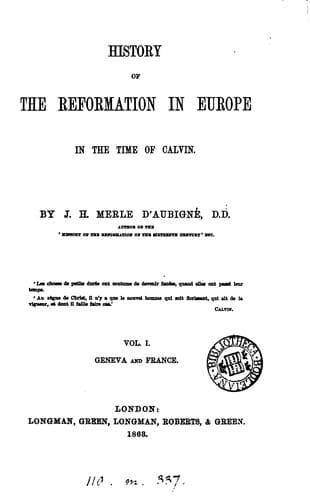
History of the Reformation in Europe in the Time of Calvin, Vol. 6 (of 8)Merle d'Aubigné, J. H. (Jean Henri)
History
History of the Reformation in Europe in the Time of Calvin, Vol. 6 (of 8)
Merle d'Aubigné, J. H. (Jean Henri)
Reformation
The deputies of Geneva, charged with the defence before the Bernese
government, of certain interests of state, were Claude Savoye,
Michel Sept, Claude Rozet, secretary of the council and father of
the chronicler; all of them true friends of the reformers and the
magistrates; and Jean Lullin, who had at last consented to form part
of the embassy, and who was the only member of the opposition.[554]
They went to Berne with Farel; and the latter having given satisfactory
explanations, the Bernese magistrates wrote, December 22, to Geneva,
‘that they and their preachers had found the Genevese confession to
be according to God’s will and the Holy Scriptures, and thereby in
conformity with their own religion.’ They added, ‘Set then these
matters in good order. May dissensions cease, and may the sinister
intrigues of the wicked be confounded.’[555]
Would the passions which actuated one part of the Genevese people allow
them to follow such good counsel? They were not to wait long for an
answer to this question.
CHAPTER VIII.
TROUBLES IN GENEVA.
(JAN. AND FEB. 1538.)
[Sidenote: AGITATION IN GENEVA.]
Six days later, December 28, Farel and Calvin appeared before the
council, and stated that they were about soon to celebrate the Lord’s
supper, and requested to be sustained in their _admonition to those
who were leading evil lives_.[556] An exhortation to live well had
nothing revolting about it. If a man is living ill, it becomes a duty
to entreat him to live well. That is most of all the duty of faithful
pastors, especially on the approach of the supper. But what need had
the ministers of being _sustained_ by the magistrate? This request
transformed a religious act into a matter of civil business, and thus
totally altered its nature. The answer to be made to the reformers
was put off until the return of the delegates sent to Berne. This
step of the reformers was irritating to those who supposed they would
be among the subjects of the admonition. Claude Sérais, who had a
free tongue, that source of all debate, said daringly in the presence
of a numerous company, ‘Farel is a bad man.’[557] Others took part
with him in censuring the ministers. They indulged in detraction, in
aspersions, in cutting speeches; they cast about in all directions
for anything which might be taken amiss. It was but a small fire at
first, but little by little it spread far and wide. On January 1 and
2 (1538) the council was occupied with the affair, and resolved that
‘those who had circulated insults against the preachers about the
town should be taken before the lieutenant, at the instance of the
attorney-general.’ ‘We shall see,’ they said, ‘who is bad, and the bad
shall be punished.’[558] The preachers made no complaint; but it was
their unfortunate application to the council which had given occasion
to these insults. This agitation would certainly not have arisen had
Public-domain text, read in full here on John Shaqi.
Reviews
Reviews
No reviews yet
Be the first to share your thoughts on this work.
Elsewhere in the archive
Join the Discussion
Join the discussion
Sign in to leave a comment or review.
Sign InorCreate an account