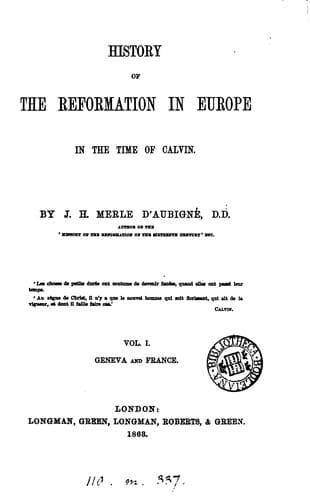
History of the Reformation in Europe in the Time of Calvin, Vol. 6 (of 8)Merle d'Aubigné, J. H. (Jean Henri)
History
History of the Reformation in Europe in the Time of Calvin, Vol. 6 (of 8)
Merle d'Aubigné, J. H. (Jean Henri)
Reformation
each pastor, in conformity with the precept of Jesus Christ--‘Go and
tell him his fault between thee and him alone’--addressed those who
were blameworthy kindly and privately. One fact, however, exonerates
the preachers: they were not at liberty to act otherwise than they
did. The state had resolutely placed itself above the Church, and was
intermeddling with matters which pertained only to the pastors. If the
latter had rebuked some citizens without the consent of the council,
they would certainly have been liable to rebuke themselves. The fault
was above all with the magistrate. Geneva sailed for some years on a
high tide of _Cesaropapia_ (government of the Church by the state).[559]
On January 3 the reformers presented themselves again before the
council. They did not come to complain of the insults to which they had
been subjected. They proposed a nobler object, the union of all the
members of the Church in the same faith and the same charity. They drew
a vivid picture of the discord which was increasing day after day, and
of the divisions which were fomented in the republic by restless and
factious spirits; and they represented that one of the best methods of
applying a remedy would be to keep the disturbers away from the supper.
‘As it is determined to celebrate it on Sunday next,’ they said, ‘we
are of opinion that, those persons should not be admitted. On this
point we desire the opinion of the council.’[560]
[Sidenote: THE CHURCH AND THE STATE.]
This exclusion proposed to the senate is one of the gravest facts in
the reformation of Geneva, and it kept up excitement in the city for
nearly a whole generation. Wherein then were the reformers right, and
wherein were they wrong? A society is a collection of men who, while
differing on some matters, are in agreement on the subject which is the
very essence of their union. A society of financiers is not composed
of people who know nothing of money matters. It is not the unlearned
who are admitted to a learned faculty. A regiment is not recruited
with one-armed men. Men who know nothing of French are not elected
to form the Forty of the Academy. It is just the same with Christian
society. Its members may differ in many respects--political, literary,
social, etc.--but Christian faith must actuate them all. A Jew or a
Mohammedan does not belong to the Church of Jesus Christ; and a man who
rejects the facts, the doctrines, and the duties of Christianity is
not a Christian. ‘Birds of a feather flock together,’ says a common
proverb. Ought the reformers to ignore such an elementary truth? There
were still some Roman Catholics at Geneva; there were the so-called
_Spirituals_, many of whom did not believe even in the immateriality
of the soul; there were also a great number of citizens who did not
consent to the faith as set forth in the confession made at St.
Peter’s. Should such a confused mass, in which it would be impossible
Public-domain text, read in full here on John Shaqi.
Reviews
Reviews
No reviews yet
Be the first to share your thoughts on this work.
Elsewhere in the archive
Join the Discussion
Join the discussion
Sign in to leave a comment or review.
Sign InorCreate an account