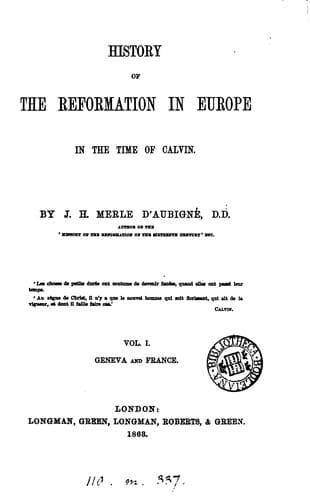
History of the Reformation in Europe in the Time of Calvin, Vol. 6 (of 8)Merle d'Aubigné, J. H. (Jean Henri)
History
History of the Reformation in Europe in the Time of Calvin, Vol. 6 (of 8)
Merle d'Aubigné, J. H. (Jean Henri)
Reformation
Thus did the magistrates give a flat refusal to the ministers. It
was a lesson for Calvin and his friends. This decision was contrary
to their convictions; but as they knew that the council was at heart
friendly to the Reformation, they did not feel bound to oppose its
will. They gave proof of moderation, conciliation, and patience. Some
will perhaps say that they pushed these virtues too far. They yielded.
That is not the crime of which they are commonly accused. The supper
was celebrated, and there was no disturbance.
[Sidenote: DISORDERS.]
But although the communion passed off in an orderly manner, troubles
arose afterwards. The opposition party looked on this general admission
as a triumph for them; and as they saw that the representations of the
ministers were no longer listened to by the councils, their audacity
increased. Again were seen bands of men, consisting of the least
respectable classes of the people, parading the city with green flowers
in their hats. They indulged in acts of violence; they annoyed those
who had sworn to the Reformation; ‘they drew their swords and terrified
others into flight.’ The taverns were thronged with these people, who
ate and drank to excess. Puns and sarcasms were showered on all sides.
Even holy things were turned into ridicule. Just as St. Paul addressed
his Epistles to his _brethren in Christ_, so the evangelical Christians
of the Reformation gave each other that title. The wags had noticed
it, and did not fail to laugh at it. ‘A party of drunken men,’ say
the Registers of January 16, ‘went in the night through the town and
to the wine-shops, mocking the preachers and saying to each other,
‘_Thou art one of the brethren in Christ_,’ and other things of the like
kind. These mockers having come to the Lord’s supper, to which all
were admitted by order of the Council, gave themselves in jest the name
of _brethren_. Jean d’Orbe said to Claude Jaccard, ‘Art thou of the
_brethren in Christ_?’ and swearing a great oath, he added, ‘Thou wilt
repent of it.’ Many persons, alarmed at these disorderly proceedings,
trembled for the general council which was to be held fifteen days
later. ‘Many a sword-thrust will be given there,’ they said, ‘so
that we shall not wish to go.’ The discord which prevailed in Geneva
agitated also the neighboring country districts. The Council of the
Two Hundred was deeply affected by all these reports, and determined
to have inquiry made and to punish the guilty. The measure which the
council adopted in order to prevent disturbances was precisely that
which actually gave rise to them.[564]
Public-domain text, read in full here on John Shaqi.
Reviews
Reviews
No reviews yet
Be the first to share your thoughts on this work.
Elsewhere in the archive
Join the Discussion
Join the discussion
Sign in to leave a comment or review.
Sign InorCreate an account