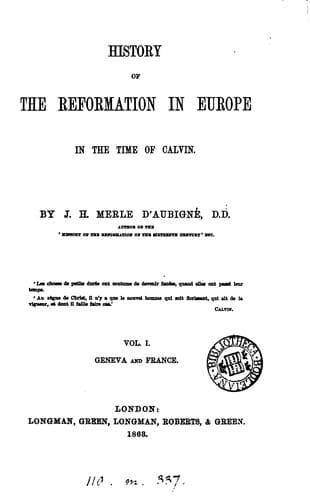
History of the Reformation in Europe in the Time of Calvin, Vol. 6 (of 8)Merle d'Aubigné, J. H. (Jean Henri)
History
History of the Reformation in Europe in the Time of Calvin, Vol. 6 (of 8)
Merle d'Aubigné, J. H. (Jean Henri)
Reformation
to know where one was, form the Church of Geneva? Should that Church be
‘De tant d’objets divers le bizarre assemblage?’[561]
Would it not in such a case remind one of certain monsters, which are
spoken of by the ancients, possessing a conformation which was against
nature? The reformers were with the truth when they answered No. But
where they were wrong was in requiring all the citizens to take an oath
to their confession. Was it possible for them to fancy that the act by
which Geneva had broken with the pope had transformed, as by the stroke
of the enchanter’s wand, all the Genevese, so that from that moment
they all believed heartily, and ought all to make confession with their
lips? _Nascitur homo, fit Christianus_, said Tertullian in the second
century. One _is born_ a man, but one _becomes_ a Christian. To pretend
that all those who belonged to the state belonged at the same time to
the Church was irrational. To decree that those who would not take the
oath to the confession should depart from the city and go elsewhither
was iniquitous. What, drive from Geneva the men to whom Geneva owed
her independence! Such an enormity could not fail to lead to a
revolution. The fusion of the Church and the state in a single society
is the origin of those blemishes which in some instances disfigured
the otherwise glorious work of the Reformation. But how to settle the
dilemma? how admit two contradictory propositions? How to exclude and
to keep at the same time?
The early Church accomplished this. It had its ἀκροώμενοι, _audientes_,
hearers. Instead of excluding those whose faith was not yet formed,
it invited them lovingly to hear the preaching of the Word. They
attended the service and joined in the prayers, without taking part
in the mysteries of the Lord’s supper, which they shrank timidly from
approaching. And when in their experience that great process of the
Christian life was accomplished of which St. Paul speaks--_Faith cometh
by hearing_--they shared the communion at the sacred feast. Perhaps
Geneva was not yet ripe for this order of things.[562]
The council assembled the Two Hundred to consider what answer should
be made to the reformers. Since the scenes which had taken place in
the council of November 25, the syndics had become more timid. They
dreaded whatever might provoke the people and drive them on to any
rash proceeding, and they felt less inclined to support the reformers.
A letter was read from Berne which bore approving testimony to the
confession, and exhorted to concord. Three of the members who had not
sworn the confession--De Lesclefs, Manlich, and Ameaux--were urged to
do as others had done. The first two took the oath required; Ameaux
alone refused. The council then believing that they had gone far
enough, recoiled from a measure which might have grave consequences,
and determined ‘not to refuse the supper to any one.’[563]
Public-domain text, read in full here on John Shaqi.
Reviews
Reviews
No reviews yet
Be the first to share your thoughts on this work.
Elsewhere in the archive
Join the Discussion
Join the discussion
Sign in to leave a comment or review.
Sign InorCreate an account