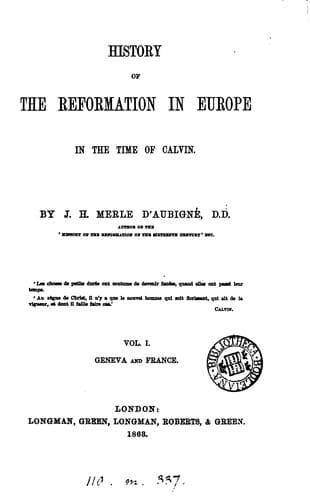
History of the Reformation in Europe in the Time of Calvin, Vol. 6 (of 8)Merle d'Aubigné, J. H. (Jean Henri)
History
History of the Reformation in Europe in the Time of Calvin, Vol. 6 (of 8)
Merle d'Aubigné, J. H. (Jean Henri)
Reformation
Was Geneva, then, going to make trial of it? February 3, the day of
election, at length arrived. The opposition, which was at the outset a
minority, but a minority of the inflexible kind which generally wins,
had succeeded in persuading the people that if they wished to keep
their liberties they must change the government. The council general
assembled in the cloisters of St. Peter’s, and the first syndic said,
after the customary formalities--‘The election of syndics is a matter
of so great importance, that it will be enough to occupy us to-day
without any other business. Let everyone give his vote peaceably, and
let no one be so rash as to stir up disorders, either by word or by
sword. Any man who does so will be sent to prison, and will afterwards
be punished according to his desert.’ The Two Hundred, according to
custom, presented eight names, and the council general was to retain
four of them. Two secretaries were at hand to enter the votes; and
presently the citizens, coming forward group by group, gave their
votes. Of the eight candidates the people chose three who had put
themselves at the head of the opposition, and whom the impartiality of
the Two Hundred had led them to present with the others. These three
were Claude Richardet, who, with furious gesture, had declared that
they would not get him to go to prison; Jean Philippe, who had proposed
in the council general to name twenty-five citizens to watch the
syndics; and Jean Lullin, who had accused the council of violating the
franchises. These three enemies of the new order of things were named
syndics. But there must be four of them. The opposition intended that
the fourth should likewise be one of their party, but it did not find
another set down in the list of the council. Regardless of the rule on
that point, they chose a citizen who had not been proposed by the Two
Hundred--De Chapeaurouge--who had greatly compromised himself by the
vehemence of his speeches against the reformers. On February 4 and 5
the election of councillors as assistants to the syndics was conducted
in almost the same spirit.
Public-domain text, read in full here on John Shaqi.
Reviews
Reviews
No reviews yet
Be the first to share your thoughts on this work.
Elsewhere in the archive
Join the Discussion
Join the discussion
Sign in to leave a comment or review.
Sign InorCreate an account