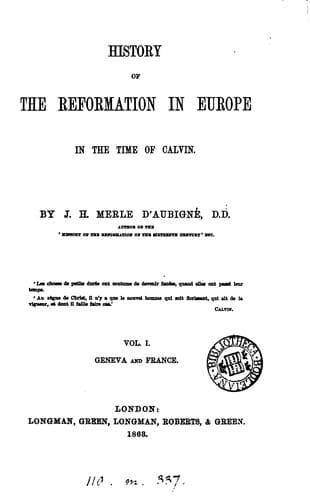
History of the Reformation in Europe in the Time of Calvin, Vol. 6 (of 8)Merle d'Aubigné, J. H. (Jean Henri)
History
History of the Reformation in Europe in the Time of Calvin, Vol. 6 (of 8)
Merle d'Aubigné, J. H. (Jean Henri)
Reformation
The victory of the opposition was complete. A great revolution had
been wrought in this small city. The citizens had come to a decision
of such a character as must excite disturbances and prepare the way
to their ruin. This soon became apparent among the lower classes.
The election was followed, especially at night, by noisy promenades,
licentious songs in the taverns, insults and blasphemies. At Geneva,
as in France, the song was one form of opposition. The people feasted,
drank, and made songs on their enemies. Thus these lawless subjects
had their triumph after their own fashion. But Calvin and Farel did
not hesitate to present themselves before the council in which their
antagonists sat, and to demand the suppression of these disorders.
The new syndics were the most decided of the citizens in the sense
opposed to the reformers; but they were intelligent men, and they
had no wish that the mischief should run to an extreme. History,
moreover, gives us many examples of a change effected in individuals
by accession to power. Sometimes an ecclesiastic vehemently opposed
to the encroachments of the Roman see has been made pope, and he has
thereupon become the most thoroughgoing papist. The magistrates had
no wish to compromise themselves at the outset by making common cause
with the libertines; they therefore ordered that justice should be
done at the demand of the pastors. The sound of the trumpet was heard
in the streets, and the officer of the council cried, ‘No one shall
sing indecent songs containing the names of the inhabitants of Geneva;
no one shall go into the city without a candle after nine o’clock at
night; no one shall create excitement or strife, under pain of being
imprisoned on bread and water, for three days for the first offence,
six days for the second, and nine for the third.’[571] Immediately
after its election the new council had given a proof of moderation and
impartiality. Jean Jacques Farel, a brother of the reformer, having
replied to the threats of the opposition that he would go armed to the
council general, had been sent to prison by the council formed of his
own party. After the new election Farel interceded for his brother, and
the new council, in its session of February 5, released him, because he
had, according to the Registers, already remained three or four days
in prison. The blustering fellows thought it very strange that the
magistrates, who set Farel’s brother at liberty, should reward them,
the men who had placed them in office, by prohibiting songs at their
tables, in the midst of their cups, which were so delightful to them.
But notwithstanding these appearances, the revolution was none the
less profound and decisive; and it is doubtful whether, even after the
trumpet-blast, the disorders ceased.
[Sidenote: MONTCHENU AT GENEVA.]
Public-domain text, read in full here on John Shaqi.
Reviews
Reviews
No reviews yet
Be the first to share your thoughts on this work.
Elsewhere in the archive
Join the Discussion
Join the discussion
Sign in to leave a comment or review.
Sign InorCreate an account