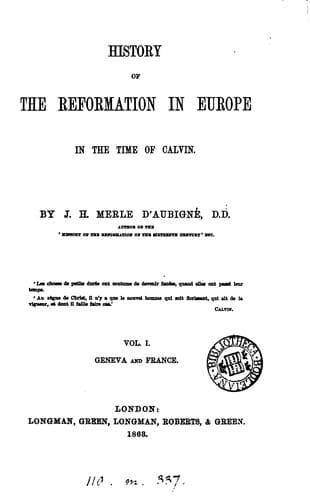
History of the Reformation in Europe in the Time of Calvin, Vol. 6 (of 8)Merle d'Aubigné, J. H. (Jean Henri)
History
History of the Reformation in Europe in the Time of Calvin, Vol. 6 (of 8)
Merle d'Aubigné, J. H. (Jean Henri)
Reformation
The conduct of the syndics with regard to those who had preceded them
showed immediately that they did not lose sight of one of the chief
objects of their election. A Frenchman, the Seigneur de Montchenu,
being at Geneva, caused letters to be sent to three Genevese
councillors, Claude Richardet, Claude Savoye, and Michel Sept, in which
it was stated that if the Genevese would become subjects of the King
of France, he would leave to them their usages and liberties, would
fortify their city, and answer for them when attacked. Berne took alarm
on hearing this, and cautioned the Genevese to be on their guard. When
the councils met they ordered answer to be made to the French agent
that Geneva would no more entertain such projects, and decreed that
every Frenchman found wandering on the territory of the republic should
be expelled. It was not easy to treat the letter which had been written
to them as a crime on the part of the three Genevese, especially as the
first to whom it was addressed was Claude Richardet, then syndic, the
fierce enemy of the ministers and the priests. Nevertheless they found
means of employing these letters without taking Richardet into account.
He, however, was not only compromised, like the other two, in having
received a letter, but there was one grave fact against him. Montchenu
having presented himself by night, with some horsemen, at the gates of
Geneva, Richardet, syndic at the time, went to them at their request,
ordered the great gate to be opened, and introduced the Frenchmen into
the city. Montchenu having proposed to Richardet to go to supper with
him at the Tête-Noire, he declined. When he was subsequently called
upon by Claude Savoye to explain this circumstance in the council,
Richardet stated that he had thought that Montchenu was going on an
embassy into Germany to bring soldiers for the king. If this adventure
had happened to either of the other Genevese who had received the
letter, Claude Savoye, for instance, what would not have been said?
But Richardet was as innocent as his compatriots. A Genevese does not
betray his country. For the rest, he assured the council that he had
had no intention but to please it.
Whatever the fact may have been, on the proposition of Monathier, one
of the most violent members of the party then in power, the council
suspended Claude Savoye and Michel Sept from their functions until
this business should be cleared up. It has been remarked that, to take
advantage of their ascendency in order to get up any bad case against
their antagonists, was a traditional propensity which Genevese parties
had too long indulged.[572] Similarly, three of the former syndics and
a councillor were suspended on account of charges brought by people
of doubtful respectability. In this way the new government secured a
majority in the Council of the Two Hundred.[573] A pitiful victory of
party spirit! Everyone was eagerly hunting up grievances against the
fallen magistrates.
Public-domain text, read in full here on John Shaqi.
Reviews
Reviews
No reviews yet
Be the first to share your thoughts on this work.
Elsewhere in the archive
Join the Discussion
Join the discussion
Sign in to leave a comment or review.
Sign InorCreate an account