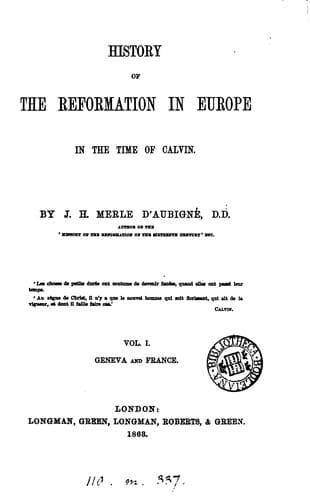
History of the Reformation in Europe in the Time of Calvin, Vol. 6 (of 8)Merle d'Aubigné, J. H. (Jean Henri)
History
History of the Reformation in Europe in the Time of Calvin, Vol. 6 (of 8)
Merle d'Aubigné, J. H. (Jean Henri)
Reformation
Having lost all hope in the institutions of the state, the reformer
turned his attention to those of the Church. So long as sincere friends
of the Reformation had been in power, Farel and Calvin had displayed
a spirit of concession even on important points. When the council,
for instance, had determined that the supper should not be refused
to anyone, they had yielded. But now, when they saw at the head of
affairs men who were opposed to order in the Church, they no longer
felt it their duty to yield. They will not allow the state authorities
to organize the spiritual body at their will. They will contend against
notions contrary, as they think, to the Word of God. They will contend
against them by their prayers and efforts, and by their resistance. The
moment is come for them to say with Luther, I can do no otherwise (_Ich
kann nicht anders_). There was enough in such a resolution to arouse
a storm. But other blasts, not less impetuous, and blowing from other
quarters, were soon to assail the reformers.
CHAPTER IX.
STRUGGLES AT BERNE.--SYNOD OF LAUSANNE.
(1538.)
The state of affairs at Berne had changed since the synod of September
1537, at which Calvin, appearing on the scene as the messenger of
peace, had brought in concord after strife. Megander, Erasmus Ritter,
and Rhellican complained of the progress of _Bucerism_, and their
adversaries complained of them as disturbers. Megander, it may be
recollected, had agreed at the time of the synod to amend his catechism
to a small extent. Now Bucer himself had in his zeal undertaken the
task, and the council, without consulting Megander, had printed the
revised and amended catechism. This was an act at once imprudent and
wanting in respect. The lords of Berne were accustomed to play to
some extent the part of autocrats. Megander was deeply wounded; and
presenting himself before the council with Erasmus Ritter, he declared
that he was fully determined not to become a Lutheran, and that
consequently he could not allow the corrections of Bucer. Kunz and
Sebastian Meyer on the other hand stoutly defended the catechism as
revised by the Strasburg doctor.
[Sidenote: STRUGGLES AT BERNE.]
Public-domain text, read in full here on John Shaqi.
Reviews
Reviews
No reviews yet
Be the first to share your thoughts on this work.
Elsewhere in the archive
Join the Discussion
Join the discussion
Sign in to leave a comment or review.
Sign InorCreate an account