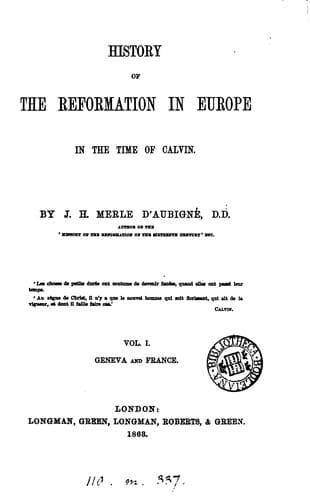
History of the Reformation in Europe in the Time of Calvin, Vol. 6 (of 8)Merle d'Aubigné, J. H. (Jean Henri)
History
History of the Reformation in Europe in the Time of Calvin, Vol. 6 (of 8)
Merle d'Aubigné, J. H. (Jean Henri)
Reformation
The State, when it intrudes into theological discussions, is wanting
in the necessary tact, and is too often influenced by considerations
foreign to religion. The council replied magisterially that the
catechism was in conformity with Scripture; and it added despotically
that Megander and Ritter must accept it as it is, or they would be
immediately deprived of their offices. Ritter, who did not find in the
catechism anything which at bottom imperilled the Christian faith,
submitted. But Megander raised objections more or less well founded.
He was wounded in his _amour-propre_ as author, and observing the
eagerness of his adversaries to annoy him, he perceived that his
position at Berne had become untenable. Therefore he held his ground
and received his _congé_: a measure in which, however, they showed
a certain consideration. It was the end of the year 1537. He then
withdrew to Zurich, which received him with open arms.[576]
This proceeding of the Bernese government excited a great sensation.
Zurich addressed to Berne a sharp remonstrance. The country pastors
of the canton of Berne complained loudly of the government and of
the ecclesiastical councillors, and inquired whether these gentlemen
meant to abjure the Reformation. A meeting was held at Aarau, January
22, 1538, at which it was resolved to make representations to the
council; and the dean of Aarau, Zehnder, named chief of the deputation,
presented the complaint. February 1 was fixed for the hearing of the
two opposing parties. But while Kunz and his colleagues were admitted
into the council chamber and took their places by the side of the
president, the dean and the country ministers waited at the door. No
sooner were they admitted than Kunz addressed them with a haughty air,
and rebuked them in a loud and stern voice. The country deans replied
that they did not mean to be ruled by the city ministers as boys are by
their schoolmaster. The discussion grew warm,[577] and even the members
of the council took part in the quarrel.
Public-domain text, read in full here on John Shaqi.
Reviews
Reviews
No reviews yet
Be the first to share your thoughts on this work.
Elsewhere in the archive
Join the Discussion
Join the discussion
Sign in to leave a comment or review.
Sign InorCreate an account