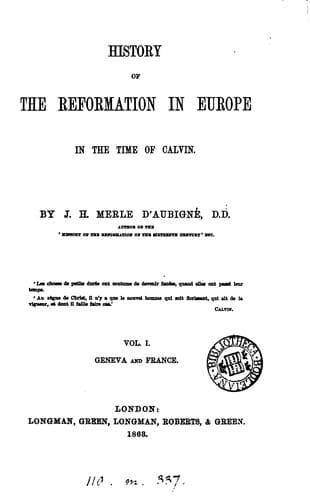
History of the Reformation in Europe in the Time of Calvin, Vol. 6 (of 8)Merle d'Aubigné, J. H. (Jean Henri)
History
History of the Reformation in Europe in the Time of Calvin, Vol. 6 (of 8)
Merle d'Aubigné, J. H. (Jean Henri)
Reformation
When the lords of Berne found that their delegates had failed in their
conference with the Genevese ministers, they resolved to write, on the
same day, April 15, two letters: one to Calvin and Farel, the other to
the council of Geneva, having no doubt that this clever contrivance
would succeed. Their two missives were very nearly alike. They urged
the ministers to accept the decision of the synod, without waiting for
the assembly at Zurich, in order that the two Churches, united in the
fundamentals of the faith, might likewise be in conformity in matters
of ceremonial. And to the council they addressed entreaties to accept
the same decision, ‘in the hope that Masters Farel and Calvin, although
they had raised some difficulties, would advise for the best.’[596]
CHAPTER X.
THE COUNTER-REFORMATION PREVAILS.--CALVIN AND FAREL REFUSE TO
GIVE THE LORD’S SUPPER.--THE PULPIT IS CLOSED TO THEM.
(APRIL 15 TO 20, 1538.)
[Sidenote: RESISTANCE OF CALVIN.]
The very circumstances which inspired the confidence of Berne were
exactly those which roused the resistance of Calvin. Those powerful and
magnificent lords could not believe that so dignified an intervention
would fail to secure submission; and Calvin could not consent that
the interests of the Church of Christ should be regulated by the
magistrate, like those of the highways and the soldiery. Besides,
in the present case, the question was about foreign magistrates. To
their intervention the citizen and the Christian could not but be
equally opposed. Calvin wished to maintain the principle of religious
liberty, and he requested that time should be allowed him to come to
an understanding with the other Churches. However, if the letter to
the ministers was unsuccessful, that sent to the council had a success
so abundant that it not only surpassed the hopes of the Bernese,
but crossed their desires and threw an obstacle in the way of their
projects. The syndics who had been named in a spirit hostile to the
reformers, and all the citizens who had placed them in office, were
delighted to see variance between Berne and Calvin and Farel. For them
it was a piece of real good fortune, although for the ministers it was
a grievous event. The two states, Berne and Geneva, acting in unison,
would soon get the better of two poor ministers. Further, the council
was at this time in a bad humor. The third preacher, the aged and
energetic Courault, who had remained at Geneva, had blamed the syndics
in one of his sermons, and it was resolved to reprimand him. It is safe
to rely, in this matter, on what the Registers state. It is not right
to receive, as some have done, the burlesque and lying imputations of
the notorious slanderer Bolsec, who, ‘after the example of Herostratos,
chose to pass down to posterity branded with infamy.’[597] The council
forbade Courault to preach. This was the state of things when the
letters from Berne arrived.
Public-domain text, read in full here on John Shaqi.
Reviews
Reviews
No reviews yet
Be the first to share your thoughts on this work.
Elsewhere in the archive
Join the Discussion
Join the discussion
Sign in to leave a comment or review.
Sign InorCreate an account