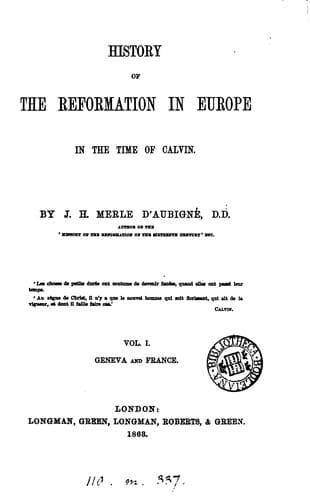
History of the Reformation in Europe in the Time of Calvin, Vol. 6 (of 8)Merle d'Aubigné, J. H. (Jean Henri)
History
History of the Reformation in Europe in the Time of Calvin, Vol. 6 (of 8)
Merle d'Aubigné, J. H. (Jean Henri)
Reformation
The council immediately gave orders that
Calvin and Farel should appear before them on Friday, April 19. It
was the Holy week, and that day was the day of the Passion. This
consideration caused no hesitation on the part of the enemies of the
Reformation. As the holy supper was to be celebrated two days later on
Easter Sunday, they were anxious to hurry forward the business. The
ministers then found themselves between the anvil and the hammer; they
must submit or fall, and do which they would, they would be weakened
and lowered. The secretary having read the letter from Berne, the first
syndic declared to the reformers that the council was determined to
accede to the demand of that city, and to conform to the usages there
established with respect to ceremonies. Then he asked them if they
would themselves observe them, and requested them to answer Yes or No.
Calvin and Farel demanded the time necessary, not merely, as has been
asserted, for reflection on the subject, but also and especially, that
the question might be settled by the competent authorities, the Swiss
synod, which in ten days (April 29) was to be held at Zurich. Meanwhile
they begged that no innovation should be made until the next supper. In
making this request Calvin pledged himself to accept whatever should
be decreed by that legitimate authority. This was on his part a large
concession. To his Scriptural and just judgment it did not appear
consistent, after separating from Roman Catholicism, still to retain
any part of the system, even were it only a trifle, such as unleavened
bread, baptisteries, and festivals. To one of the latter, especially,
he felt great objection. He knew that small concessions lead on to
large ones, and he feared that Rome would act according to the proverb,
and if you gave an inch would take an ell. It is needless to repeat how
decided and firm Calvin was, and yet, out of love for peace and for
unity, he conceded to his adversaries what he might justly have refused
them. All he asked was that they would wait for ten days the decision
of the synodal authority. This, assuredly, was not saying No in an
absolute manner.[598] It was quite the reverse; and the adversaries
of Calvin ought rather to have wondered at his compliance than have
blamed him for his inflexible obstinacy. His request was fair, and it
ought to have been granted. But they would not listen to it. It was
ordered that the supper should be celebrated conformably to the Bernese
usage; and the council appointed the magistrates who were to take care
that it was thus celebrated in the churches of St. Peter, St. Gervais,
and Rive. It may be asked how it was that men who were by no means
remarkable for their attachment to traditional observances should be so
obstinate in sacrificing the ritual of Geneva to the ritual of Berne.
Impartial judges have said, ‘The Council had taken this resolution in
order to win over the Bernese and to implicate them in the opposition
Public-domain text, read in full here on John Shaqi.
Reviews
Reviews
No reviews yet
Be the first to share your thoughts on this work.
Elsewhere in the archive
Join the Discussion
Join the discussion
Sign in to leave a comment or review.
Sign InorCreate an account