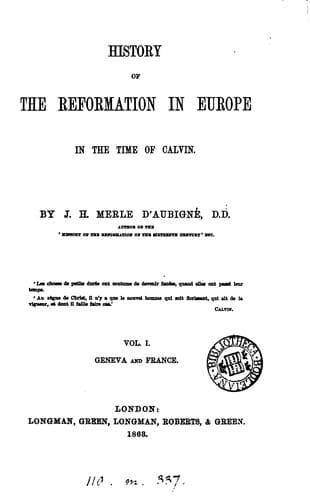
History of the Reformation in Europe in the Time of Calvin, Vol. 6 (of 8)Merle d'Aubigné, J. H. (Jean Henri)
History
History of the Reformation in Europe in the Time of Calvin, Vol. 6 (of 8)
Merle d'Aubigné, J. H. (Jean Henri)
Reformation
These disorderly deeds had lamentable consequences. Neither Farel
nor Calvin complained of them. They had now at heart interests more
important than their own, more precious even than their lives. They
did not return evil for evil. But the former preacher to the Queen
of Navarre, the blind and aged Courault, was not so forbearing. He
likewise had heard these insults. A man of integrity and devoted to
duty, he had at the same time a heart easily wounded, and he knew how
to speak hard words. The night between Friday and Saturday, during
which these cries had resounded in the city, was not a pleasant or a
peaceful one for him. He was more irritated, perhaps, on account of
the indignities which were heaped upon Calvin and Farel than for what
concerned himself. Chagrin, disquietude, and anger kept him sleepless.
His blood was heated, his heart was incensed, his imagination inflamed.
‘Je me tourne et m’agite et ne peux nulle part
Trouver que l’insomnie, amère, impatiente,
Qu’un malaise inquiet et qu’une fièvre ardente.’[602]
The state of poor old Courault seems to be described in these lines.
To him these disorders were intolerable, and he said that if men
should hold their peace the very stones would cry aloud. He would cry
out, and cry out in the pulpit. True, that was forbidden him; but no
matter, in spite of the prohibition of men he would preach. He rose
very early and went to St. Peter’s church to perform the service of
six o’clock A.M., with no other preparation, alas! than the
distress and bitterness which had preyed on his mind through the
night. The character of his preaching was not such as was wanted for a
people so sensitive as the Genevese. His eloquence somewhat resembled
that of the monks to whose order he had belonged, which consisted,
for the most part, in making a noise and in shouting.[603] His mind
was not cultivated, but he had a glowing imagination, which animated
his discourse and enabled him to hit hard blows. Although he was of
a more serious turn, he shared, to some extent, the faults of the
most illustrious orators of the preceding period, Barletta, Maillard,
and Menot; and he sometimes attacked, as they did, the vices of his
hearers by satire occasionally delicate and occasionally coarse, but
always prompted by a good and grave intention. He would now discharge
his conscience. Let them put him in prison, banish him, or beat
him soundly; his soul, wearied with grief, must burst its bonds.
He uttered, doubtless, some excellent things, some true and pious
words; but, agitated as he was, he allowed himself to indulge in that
intemperate mode of speech which was then so common. With his spirit
still disturbed by those noisy and tumultuous crowds collected under
the windows of the reformers, from the midst of which came redoubled
shouts, jesting songs, insults, accusations, and menaces, he likened
them to the ‘kingdom of the frogs,’ that from the bosom of the marshes
croak and make a loud noise.
Public-domain text, read in full here on John Shaqi.
Reviews
Reviews
No reviews yet
Be the first to share your thoughts on this work.
Elsewhere in the archive
Join the Discussion
Join the discussion
Sign in to leave a comment or review.
Sign InorCreate an account