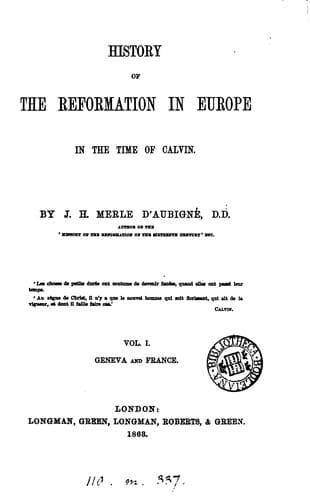
History of the Reformation in Europe in the Time of Calvin, Vol. 6 (of 8)Merle d'Aubigné, J. H. (Jean Henri)
History
History of the Reformation in Europe in the Time of Calvin, Vol. 6 (of 8)
Merle d'Aubigné, J. H. (Jean Henri)
Reformation
to the reformers.’[599] We confess that this explanation appears to us
very probable.
[Sidenote: DISTURBANCES AT GENEVA.]
This decision was despotic, and in that very quality was in accordance
with the order which the councils intended to establish at Geneva, that
of _Césaropapia_, in which the prince and the magistrate, taking the
place of the pope, settle everything in the Church. The inflexibility
of the council on the one side and the firmness of the reformers on
the other came into collision, and the result was a shock to the
people which troubled their everyday life and could not, but lead to
a conflict. Those who formed the lowest section of the opposition,
excited and agitated, began to cry out against the resistance of the
ministers, and they thought that if the latter would not obey with a
good grace, they must be compelled to yield by terror and by force.
If the people were to express their will with energy, if they took up
arms, and filled the streets and massed themselves like roaring waves
in front of the houses of Farel, Calvin, and Courault, those men, no
matter what their strength might be, would have no choice but to give
way before that impetuous torrent. ‘Thereupon,’ says the chronicler
Rozet, ‘great excesses and blasphemies were committed. Dissolute men
went about the town by night in dozens, armed with arquebuses, which
they discharged in front of the ministers’ houses. They shouted, _The
Word of God!_ and after that, _The word of Andrew!_ They threatened
to throw them into the Rhone if they did not come to some agreement
with the magistrates respecting the ceremonies in question; and these
proceedings, all open and notorious, went unpunished.’[600] It is not
easy to ascertain what the cry, _The word of Andrew_, meant.[601]
The cry, _To the Rhone!_ was invariably heard at Geneva when popular
risings took place. Froment was greeted with it when he began to preach
the Gospel there; and some women would have thrown him _over the
bridge_ (_du pont en bas_) if a party of men had not rescued him. They
did not, indeed, fling every one into the Rhone whom they threatened;
but these cries could not but seem to Farel and Calvin a mournful
return for their great and severe labors.
[Sidenote: INDIGNATION OF COURAULT.]
Public-domain text, read in full here on John Shaqi.
Reviews
Reviews
No reviews yet
Be the first to share your thoughts on this work.
Elsewhere in the archive
Join the Discussion
Join the discussion
Sign in to leave a comment or review.
Sign InorCreate an account